


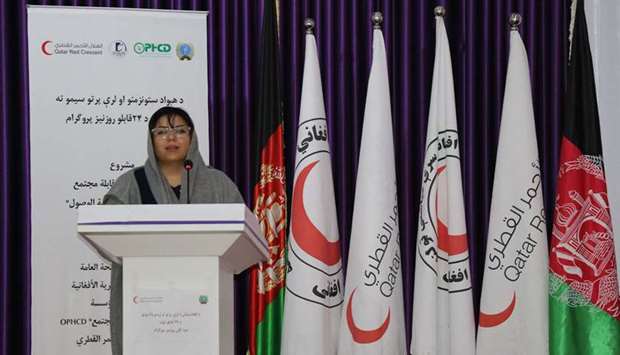
Qatar Red Crescent Society (QRCS) has inaugurated a significant project to train community midwives in remote and underserved parts of Afghanistan.
At a total cost of $490,055 (around QR1.8mn), the scheme is being co-implemented by the Afghan Welfare Society, Organisation for Promotion of Health and Community Development, Ministry of Health (MoH) and provincial health chapters.
The purpose of the new project is to qualify 24 trainees as community midwives in the remote and inaccessible areas of eight provinces: Badakhshan, Bamyan, Ghazni, Zabul, Kunduz, Wardak, Faryab and Nuristan, QRCS has said in a statement.
During the 24-month training, the trainees will acquire the relevant knowledge and skills through theoretical and applied training programmes at specialised hospitals and/or health centres, in accordance with the MoH’s training programme.
After that, the trainees will receive graduation certification from Afghanistan’s Supreme Council for Nursing and Midwifery. They can find jobs at fixed or mobile health facilities in remote areas, operated by the MoH or other service providers, such as the Afghan Red Crescent Society (ARCS) or other partners. Alternatively, they can be self-employed, offering basic health services in their own districts.

Apart from the theoretical and practical aspects, the programme also provides all training resources, such as trainers, materials and full-board accommodation. After graduation, each midwife is expected to offer primary health services, particularly in reproduction health, for up to 4,800 cases per year within her own demographical sphere, which means an annual average of 84,480 in all locations of the graduates.
The inaugural ceremony took place at the Moora Centre in Afshar district, Kabul, which hosts the classes and dormitory. It consists of an elementary-and-high school, as well as a university for girls, with colleges like the School of Medicine and Health Sciences. Therefore, the premises are perfect for girls from rural areas, the statement adds.
The ceremony was attended by representatives of the MoH, ARCS, Ministry of Economy, Supreme Council for Nursing and Midwifery, Shura Councils and health offices in target provinces. Other attendees included teachers, supervisers, trainers, trainees and local community leaders.
Zabihullah Atal, MP for Badakhshan, said: “I would like to thank QRCS and all partners and contributors for this vital project. The participants in this course are expected to play a major role in the future to alleviate the pain of many mothers and reduce mortality rates."
Rashida, a trainee from Nuristan, added: “I am lucky to be here in this excellent course. The teachers and trainers are great and do their best to teach us. I think of the suffering of the mothers in my neighbourhood due to lack of health services. I hope I will be able to help them in the future. Thank you QRCS for sponsoring this course and helping the poor parts of my country."