


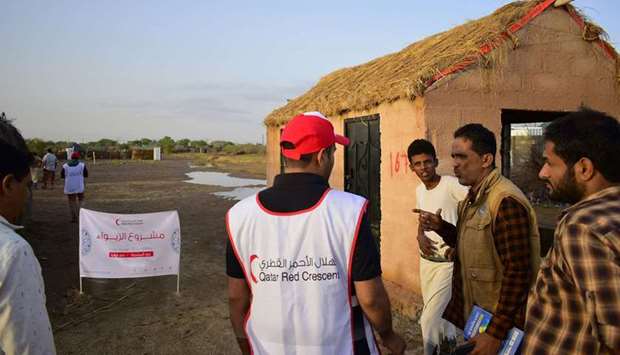
Qatar Red Crescent Society (QRCS) has completed a project to provide shelter for the internally displaced persons (IDPs) affected by the war and flooding in Yemen. At a total cost of $210,024, 224 housing units were handed over to the beneficiaries in two sub-divisions of 'Abs District, Hajjah Governorate.
The handover ceremony was attended by representatives of the Supreme Council for Management and Coordination of Humanitarian Affairs in Hajjah and the local authority of 'Abs. Eng. Younes Mansour, the delegate of QRCS, gave a detailed presentation on the construction process. He said the project was part of QRCS’s ongoing efforts to help the Yemeni people and alleviate their suffering due to the many years of humanitarian crisis.
Eng. Mansour explained that the new houses adopted a practical and flexible model that dealt with changing weather and, at the same time, ensured environmental sustainability, using building materials from the local environment. “That is why these houses drew attention from local authorities and humanitarian organizations,” he added.
Even though the new houses are located in five distant villages, the construction was accomplished within only three months, while all technical specifications were taken into consideration.
Ahmed Hassan Hayjan, a community leader, praised QRCS’s quality of work: “I hope that these services will continue, to secure the household needs, such as mattresses, blankets, mosquito nets, and kitchenware. The people here were forced out of their home villages to live in desert areas with no shelter or food. Thanks to coordination between QRCS and local authorities, these unlivable places were turned into environmentally friendly residential villages”.
The beneficiary IDPs thanked QRCS for providing them with houses that protect their safety and dignity. Mohamed Ali Heba, a beneficiary, said, “Due to the war, my house was destroyed. I came here with my family, just to seek shelter under trees. With its commendable sympathy, QRCS gave us these houses to protect us against the heat, cold, and rain. Many thanks to QRCS. We really appreciate it”.
According to 2020 UN estimates, there are 3.1 million Yemenis in dire need for shelter and household supplies. So, QRCS’s project addresses a growing shelter issue and meets the stressing needs of the most vulnerable IDPs.
Currently, two similar projects are in progress, with a total of 580 houses to be built in the governorates of Raymah, Al Hudaydah, Taiz, and Hadhramaut, with an overall budget of $710,500.
##End of Text##
About Qatar Red Crescent (QRCS)
Established in 1978, Qatar Red Crescent Society (QRCS) is a humanitarian volunteering organization that aims to assist and empower vulnerable individuals and communities without partiality or discrimination.
QRCS is a member of the International Red Cross and Red Crescent Movement, which consists of the International Federation of the Red Cross and Red Crescent Societies (IFRC), the International Committee of the Red Cross (ICRC), and 191 National Societies. QRCS is also a member of several GCC, Arab, and Islamic organizations, such as the Islamic Committee of International Crescent and the Arab Red Crescent and Red Cross Organization (ARCO). In this legally recognized capacity, QRCS has access to disaster and conflict zones, thus serving as an auxiliary to the State of Qatar in its humanitarian efforts — a role that distinguishes it from other local charities and NGOs.
QRCS operates both locally and internationally and has ongoing international relief and development projects in a number of countries throughout the Middle East, Asia, Africa, and Europe. QRCS's humanitarian actions include providing support in disaster preparedness, disaster response, risk reduction, and disaster recovery. To mitigate the impact of disasters and improve the livelihoods of affected populations, QRCS provides medical services, healthcare, and social development to local communities. It is also active at the humanitarian advocacy front. With the help of a vast network of trained, committed staff and volunteers, QRCS aspires to improve the lives of vulnerable people by mobilizing the power of humanity.
QRCS works under the umbrella of the seven international humanitarian principles: humanity, impartiality, neutrality, independence, voluntary service, unity, and universality.