


A Conservative Party row over cuts to UK foreign aid spending is a warning of bigger challenges to come for Chancellor of the Exchequer Rishi Sunak, as he tries to repair public finances battered by the pandemic.
Privately, officials acknowledge the government has its hands full in Parliament despite holding a significant majority, because a group of MPs in Boris Johnson’s ruling party have repeatedly shown their willingness to rebel.
That’s proved especially problematic on foreign aid, which is legally mandated at 0.7% of gross domestic product. Sunak wants to temporarily reduce the level to 0.5% until the country’s finances have recovered from the pandemic, but the government has not offered a vote on the measure.
That’s angered the Tory rebels, who were thwarted by parliamentary procedure in their attempt to use different legislation to force Sunak into a U-turn on Monday. They pressed for an emergency debate in Parliament yesterday, suggesting they’re not about to back down.
The backlash represents a significant challenge for Sunak, who will face far larger spending decisions as he tries to put the government onto a more sustainable footing. The cut to overseas assistance would save the Treasury about £4bn ($5.7bn) this year, barely scratching the surface of a deficit of more than £300bn — the most in British peacetime.
An official said the spending pressures on Sunak are huge, hence the chancellor’s preference is to announce policies at fiscal events — such as budgets and spending reviews — so the Treasury can work through all the trade-offs at the same time. A second official said the government will restore the lost aid spending when the fiscal situation allows, and it’s right to prioritise spending on public services in the meantime.
Johnson’s spokesman, Max Blain, told reporters yesterday the government has no plan to put the foreign aid decision to a vote in Parliament, and that ministers believe a temporary cut is provided for in current legislation.
Still, the row suggests Sunak will have to tread carefully as he looks for savings, while also trying to fuel a recovery.
“Trying to do both at once just makes it harder to really achieve either,” James Smith, research director at the Resolution Foundation, said in an interview. Spending rules envisaged in the Tory party’s 2019 election manifesto also complicate matters for Sunak, he said, because they create a “fiscal straitjacket” for the chancellor.
The tension between what the Tories promised in 2019 and Sunak’s current plans lies at the heart of the rebellion over foreign aid. Former International Development Secretary Andrew Mitchell, who is leading the challenge against the government, told Parliament the rebels would have won by at least nine votes had support for their stance been tested on Monday.
“This is a manifesto commitment and it’s enshrined in law,” said Harriett Baldwin, a former Tory international development minister. “You can’t go pro-actively into a budget year aiming to reduce it without the consent of Parliament.”
There have been other spats over spending. Earlier this year, Tory backbenchers pressured Sunak into extending a temporary 20 pounds-a-week uplift in welfare payments until October.
Last week, Johnson’s own education czar resigned after the government announced spending on catch-up classes for children that was just a 10th of the budget he recommended.
For Sunak, the conundrum is how to repair the books, without squashing the recovery and while still delivering on the ‘leveling up’ agenda that helped the Tories to a landslide victory in 2019. The former implies an eye on debt and the deficit, the latter two point to spending.
The chancellor has himself described fiscal sustainability as a “sacred” duty to ensure Britain is prepared for the next crisis, whenever it comes.
“If the Treasury is just worrying about a deficit problem, it should be focused on tax rises that can stick or spending cuts that can stick,” said Carl Emmerson, deputy director at the Institute for Fiscal Studies. In terms of pressures on Sunak, he said: “It’s easy to come up with lots of reasons why we’ll spend more; it’s harder to come up with reasons why we’ll spend less.”
The chancellor will probably need to fork out more than he’s earmarked for ongoing Covid costs, Emmerson said. Catchup education may need enduring support, and the National Health Service may need more resources, he said.
The Resolution Foundation’s Smith said Sunak should prioritise the recovery before focusing on balancing the books. But he acknowledged it’s politically difficult to trim spending in the run-up to the next election, due in 2024.
The party’s internal divisions also complicate matters. The split on aid represents that “clash,” according to Nicky Morgan, a Tory peer who served in Johnson’s cabinet until last year.
The aid cut polls well among voters — especially in the historically Labour seats — dubbed the Red Wall — in northern England that propelled Johnson to victory on 2019. Opposition has come from Conservative MPs in more traditional Tory heartlands.
“The chancellor has some very difficult decisions, because you have some areas of spending that are protected or politically cannot be touched, and that just means there are other areas that are even more vulnerable than they normally would be,” Morgan said.
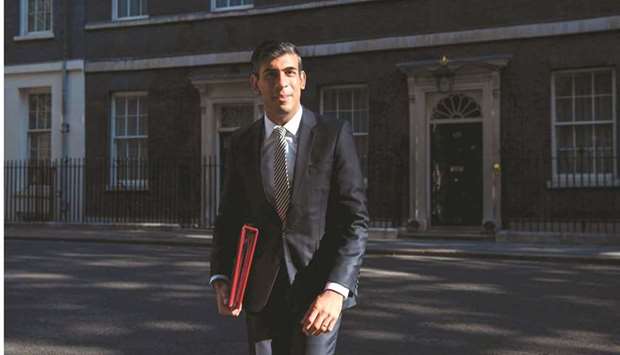
For Sunak, the conundrum is how to repair the books, without squashing the recovery and while still delivering on the ‘levelling up’ agenda that helped the Tories to a landslide victory in 2019.