


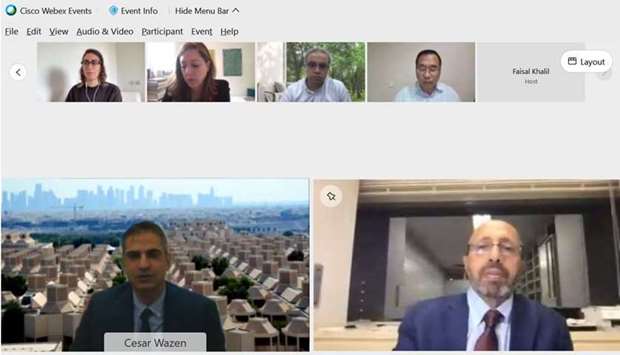
Qatar University (QU) hosted a webinar on 'Implications of the Iran-China Strategic Co-operation Agreement on the Gulf Region', featuring a number of experts in the field.
The event was organised by the International Affairs Office at the QU President’s Office in collaboration with the Gulf Studies Centre at the university's College of Arts and Sciences.
The webinar aimed to shed light on the recent China-Iran deal amid global tensions and attempts to isolate Iran.
The deal, which tackles a number of areas, including energy, banking and infrastructure, comes on the 50th anniversary of the establishment of the Iran-China relations, the QU said in a statement.
Cesar Wazen, the director of the International Affairs Office at the QU, moderated the session that featured a number of experts on the topic:
* Dr Dina Esfandiary, senior adviser in the International Crisis Group’s Middle East and North Africa Department;
* Dr Wu Bingbing, State of Qatar chair professor in Middle Eastern Studies at Peking University;
* Dr Sanam Vakil, deputy director of the Middle East North Africa Programme – Chatham House;
* Dr Mahjoob Zweiri, director of the Gulf Studies Centre;
* Dr Abdullah Baabood, State of Qatar chair for Islamic Area Studies and visiting professor at the College International Liberal Studies, Waseda University.
This marked the first event featuring both chair professors of the State of Qatar.
Participants agreed that the implications of the Iran-China deal on the Gulf region will be limited, as it seems to be a reaction to the ongoing issues with the US rather than a strategy for collaboration.
In fact, China’s involvement in the region is generalised to all countries and the deal will not create issues with other countries.
On the contrary, strengthening weak countries in the region is perceived by China as a source of stability for all countries.
Despite the lack of clarity on the way forward, the current period was deemed to be one of rebalancing of external interests in the region offering opportunities for more dialogue and co-ordination between countries.
Particularly, Qatar’s interests, from LNG exports to China to trade deals with Iran, if affected, will be positive due to its historically good relations with both countries.
The event was organised by the International Affairs Office at the QU President’s Office in collaboration with the Gulf Studies Centre at the university's College of Arts and Sciences.
The webinar aimed to shed light on the recent China-Iran deal amid global tensions and attempts to isolate Iran.
The deal, which tackles a number of areas, including energy, banking and infrastructure, comes on the 50th anniversary of the establishment of the Iran-China relations, the QU said in a statement.
Cesar Wazen, the director of the International Affairs Office at the QU, moderated the session that featured a number of experts on the topic:
* Dr Dina Esfandiary, senior adviser in the International Crisis Group’s Middle East and North Africa Department;
* Dr Wu Bingbing, State of Qatar chair professor in Middle Eastern Studies at Peking University;
* Dr Sanam Vakil, deputy director of the Middle East North Africa Programme – Chatham House;
* Dr Mahjoob Zweiri, director of the Gulf Studies Centre;
* Dr Abdullah Baabood, State of Qatar chair for Islamic Area Studies and visiting professor at the College International Liberal Studies, Waseda University.
This marked the first event featuring both chair professors of the State of Qatar.
Participants agreed that the implications of the Iran-China deal on the Gulf region will be limited, as it seems to be a reaction to the ongoing issues with the US rather than a strategy for collaboration.
In fact, China’s involvement in the region is generalised to all countries and the deal will not create issues with other countries.
On the contrary, strengthening weak countries in the region is perceived by China as a source of stability for all countries.
Despite the lack of clarity on the way forward, the current period was deemed to be one of rebalancing of external interests in the region offering opportunities for more dialogue and co-ordination between countries.
Particularly, Qatar’s interests, from LNG exports to China to trade deals with Iran, if affected, will be positive due to its historically good relations with both countries.