


The UK scaled back its bond sale plans by more than expected after the budget deficit undershot official forecasts during a pandemic-blighted year that ravaged the public finances.
The Debt Management Office announced it intends to issue £252.6bn ($351bn) of gilts in 2021-22, some £43.4bn less than previously envisaged. That’s a bigger revision than some banks projected – JPMorgan Chase and Co saw a reduction of between £25bn to £30bn. Chancellor of the Exchequer Rishi Sunak still faces an enormous task to repair the damage inflicted by the coronavirus crisis, which has pushed government debt to record levels.
“It’s certainly a big cut, though it has the effect of making an extremely high number somewhat less daunting rather than transforming the outlook,” said John Wraith, head of UK and European rates strategy at UBS Group AG.
“We are still set for heavy positive net supply, by historic UK standards, from late 2021 onwards.”
While gilts initially rallied at the open, they soon reversed to under-perform equivalent German bonds. The yield on 10-year gilts was little changed yesterday in London.
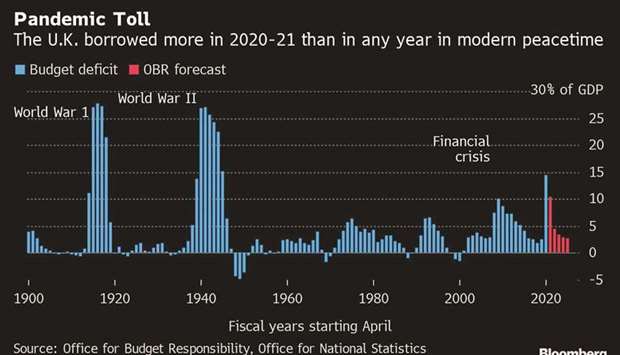
The revision followed figures from the Office for National Statistics that showed Britain recorded its largest budget deficit in peacetime history, even if it was a smaller one than had been expected.
A £28bn budget deficit in March took the shortfall for 2020-21 as a whole to £303.1bn, the equivalent of 14.5% of gross domestic product. The Office for Budget Responsibility had forecast a gap of £327.4bn.
While the DMO expects the number of gilt auctions to fall by 10 to 83 over the course of the year as a result of this revision, the squeeze will not be immediately felt as its April-June sales calendar is unchanged. Traders don’t need to look far for supply at the long-end of the curve, with the syndication of a new conventional gilt maturing in 2051 next week.
In his budget on March 3, Sunak hit companies with the biggest tax hike since the early 1990s to help pay the bill for supporting businesses and workers through the crisis.
However, economists say more may be needed if he wants to balance the books, given the pressures to boost pay and public services following the worst economic slump in three centuries.
The deficit last year was easily the largest since World War II and dwarfed the £157.7bn at the height of the financial crisis in 2009-10. Debt at the end of March stood at £2.14tn, close to 100% of economic output for the first time since the early 1960s. That affordable for now, thanks to the Bank of England’s enormous bond-buying programme keeping interest rates low.
Borrowing in the current fiscal year is still forecast to total well over £200bn, four times the deficit in the year before the pandemic struck.
That partly reflects Sunak’s announcement of an additional 65 billion pounds of stimulus to extend relief programmes such as wage subsidies for furloughed workers well beyond June 21, the date the government hopes to lift all remaining restrictions.
The latest headline OBR forecast was for a deficit in 2020-21 of £354.6bn. That figure included £27.2bn of assumed write-offs of state-guaranteed loans made to companies during the crisis. Those costs have yet to be reflected in the figures published by the Office for National Statistics.
The undershoot last year reflected government departments spending less than had been expected, particular on health. Overall, spending rose about 27% from the previous year, while tax income fell almost 5%.
UK graph