


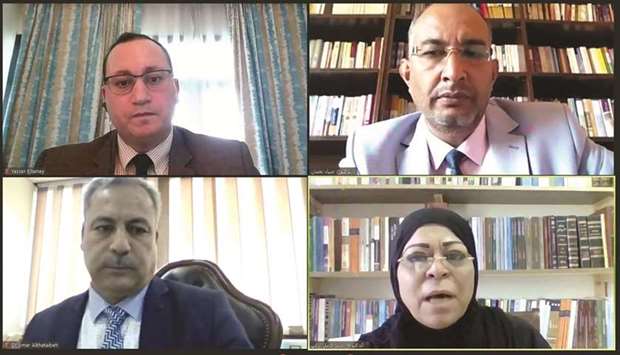
The Qatar International Centre for Conciliation and Arbitration (QICCA) at Qatar Chamber recently concluded ‘Legal Week’ with a webinar titled ‘Legal Criteria and Cybersecurity Requirements’.
Addressing the webinar, QICCA board member for International Relations Sheikh Dr Thani bin Ali al-Thani lauded the success of ‘Legal Week’, which saw the participation of more than 740 participants and 26 speakers from Qatar and other countries.
Sheikh Thani stressed that the event will be held annually to highlight issues and topics related to arbitration, the law, and other trends. He said the State of Qatar “and its Wise Leadership” attaches “great interest on cybersecurity,” referring to the Amiri Decision recently issued on the establishment of the National Agency for Cybersecurity.
He noted that this aims to maintain national cybersecurity, enhance the vital interests of the country, prepare a national strategy for cybersecurity, develop frameworks for managing cyber risks, and prepare a national plan for response and recovery from cyber incidents and attacks.
He also added that Qatar developed the country’s technological infrastructure to combat all kinds of cybercrimes and sought to strengthen cooperation with other countries in this regard.
Moderated by Dr Diaa Noaman, the last session of ‘Legal Week’ highlighted many topics, such as the protection of personal data, the legal controls for cybersecurity, the implications of cybercrimes in the Arab countries, and the rehabilitation of lawyers and its impact on the cybersecurity of justice.
Professor of Criminal Law at Police College Dr Yasser el-Lamey talked about the protection of personal data between reality and expectations. He noted that the development of information technology and artificial intelligence is accompanied by a development in cybercrimes, stressing that the new legislation and laws have helped in safeguarding the confidentiality of personal data and information not to be used for commercial purposes.
El-Lamey also stressed the importance of issuing legislation to protect the privacy of personal data and at the same time guarantee the right to access information, as well as confirm the commitment of states to apply the principle of transparency regarding the measures which might have an impact on the privacy of personal data.
Professor of Public International Law Dr Mona Kamel Turki discussed legal controls for cybersecurity, saying that digital information is a treasure trove and is closely linked to the politics of economic countries and international systems.
She also reviewed laws, regulations and instructions related to cybersecurity, measures needed for enhancing it, as well as the different types of cybercrimes.
She emphasised the importance of establishing a co-ordinated system for cybersecurity to avoid cybercrimes, establishing a focal point for managing cyber incidents, and developing plans, procedures, and protocols regarding the response during emergency cases.
Dr Abdulmoneam Abdulhafiz, an expert in cybercrimes in Sudan, reviewed the effects of cybercrimes in Arab countries. He stressed that combating these crimes require developing legislations and laws, enhancing co-operation between countries, in addition to raising awareness of the use of electronic devices and applications and activating the media role to raise awareness of the dangers of these practices.
Dr Omar al-Khataibeh of Al Lhataibeh Centre for Arbitration & Law and Legal Training in Jordan discussed the role of lawyers and their impact on the cybersecurity of justice, stressing the importance of training lawyers academically, technically, practically, and linguistically.