


* Qatar observes World Autism Awareness Day
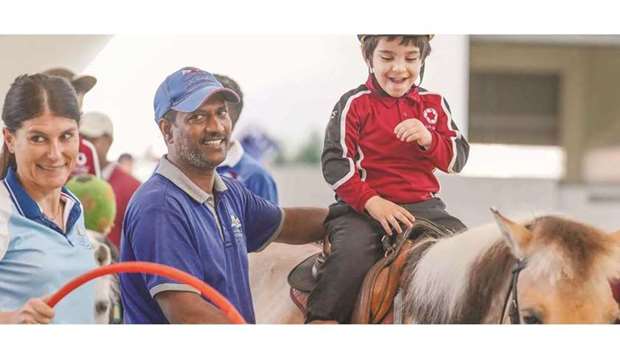
With World Autism Awareness Day marked on April 2, Al Shaqab, the equine and equestrian centre at Qatar Foundation (QF) is offering a unique programme to help and support children diagnosed with autism.
“Horses have an amazingly positive and empathic power, and when a horse and a child with autism start interacting, they eventually build a special bond with each other,” says, Chiara Rosi, a certified therapeutic instructor at Al Shaqab’s Equine Education Department who is responsible for providing the therapeutic riding lessons for autistic children.
“A child with autism may find it difficult to understand non-verbal signals. Horses give non-verbal cues through their body language, and children gradually learn to pick up these non-verbal cues and begin to understand them better. I use this to help the children understand and interact with other people around them, and it also helps them to control their tone of voice and their body language,” she explained.
According to Rosi, equine therapy offers a wide range of benefits for children with autism from psychological to social and educational.
“When a child has a control over a horse, and that horse responds to the child’s command, it boosts their confidence level,” she continued. “They feel a sense of general wellbeing, while also having reduced feelings of insecurity and fear.”
Presently the programme offers its services to parents, Qatar Autism Society, and Renad Academy school, a specialised school, part of QF’s Pre-University Education and helps children with autism.
Rosi also highlighted how this form of therapy promotes the development of respect, responsibility, perseverance, and love toward animals, and that the positive attitude that children acquire from the experience improves their social integration. It can also advance their cognitive and language skills.
“Children with autism often have difficulty comprehending normal instructions,” she said. “By engaging in equine therapy, children follow directions through a fun activity that makes taking direction easier to grasp and remember.
“Equine therapy teaches students that relationships involve responsibility; for example, some lessons begin or end with the student brushing, cleaning, or feeding the horses. This allows them to establish a relationship of trust with the horse and build a stronger bond.”
“We offer lessons to almost 65 Renad Academy students, and we currently have seven classes with each student attends one class per week. Each class is divided by age and by the scale of Autism, consisting of a 30-minute equine therapy lesson at Al Shaqab’s indoor arena, and 15 minutes of stable management and grooming the horse,” she noted.
According to Rosi, the way these lessons have helped children with autism to deal with the challenges they face are clear.
She remarked, “In equine therapy, any kind of improvement has to be assessed over the long-term, and never over just a short period of time. The first success indicator is that all the students participate positively and cheerfully in the lessons. I have noticed improvements in the way many of the students communicate with me, their level of confidence and the way they socialise in terms of making eye contact and their use of language.
“There is a significant reduction in the severity of autism symptoms and hyperactivity at the end of the initial lessons compared to when they started. Children know that a horse will not judge them, and this helps them feel safe and consequently bond easily with the horse. My goal is to help the children to interact with the horse and use its movement and rhythm to achieve therapeutic goals”.
“With the support of QF’s Community Development, we are working to improve and enhance the current programme, increase its resources, and offer it to a wider range of people throughout Qatar,” she added.