


President Volodymyr Zelenskiy has accused Moscow of building up troops on Ukraine’s border as his top ministers discussed the escalating security situation with Western allies.
He spoke after Ukrainian and US officials this week reported Russian troop movement in annexed Crimea and on the Russian-Ukrainian border, near territories controlled by Moscow-backed separatists.
“Muscle-flexing in the form of military exercises and possible provocations along the border are traditional Russian games,” Zelenskiy said in a statement.
He accused Moscow of seeking to create “a threatening atmosphere” as Kyiv hopes to resume a ceasefire brokered last year.
And Russia warned yesterday that a serious escalation in the conflict in Donbass could “destroy” Ukraine as the North Atlantic Treaty Organisation (Nato) voiced concern over what it said was a big Russian military build-up near eastern Ukraine.
Unverified social media footage has suggested Russia has been moving large quantities of tanks, armoured personnel carriers and other equipment to regions that border Ukraine as well as to Crimea, which Moscow annexed from Ukraine in 2014.
The Russian activity poses an early challenge to US President Joe Biden’s administration, which this week held phone calls with senior Ukrainian officials in a public show of support for President Volodymyr Zelenskiy’s government.
“Partly, it is the usual tactics, turning up and down the conflict to create instability, to show that Russia is a key player,” said one EU diplomat. “We cannot exclude that Biden’s presidency is part of the Russian calculus, that it’s time for Moscow to show a bit of muscle.”
This week, Moscow and Kyiv blamed each other for a rise in violence between government forces and Kremlin-backed separatists in eastern Ukraine, which has undermined the ceasefire.
Zelenskiy said that 20 Ukrainian servicemen had been killed and 57 wounded since the start of the year.
The military announced yesterday that a Ukrainian soldier was wounded in an attack it blamed on separatists.
Yesterday, US Secretary of Defence Lloyd Austin called his Ukrainian counterpart Andriy Taran, the Ukrainian ministry said, adding that Washington said it would “not leave Ukraine alone in the event of escalating Russian aggression”.
And Ukrainian Foreign Minister Dmytro Kuleba discussed the “aggravation by the Russian Federation of the security situation” on the frontline with his Canadian counterpart Marc Garneau.
Ukraine’s military intelligence accused Russia of preparing to “expand its military presence” in separatist-controlled Donbass (eastern Donetsk and Luhansk) regions.
In a statement, the intelligence service said it “does not rule out” an attempt by Russian forces to move “deep into Ukrainian territory”.
Moscow has repeatedly denied sending troops and arms to buttress the separatists, and Russian President Vladimir Putin’s spokesman Dmitry Peskov stressed yesterday that Moscow is at liberty to move troops across its territory.
“The Russian Federation moves its armed forces within its territory at its discretion,” Peskov told reporters, but he did not directly confirm a troop buildup on the Ukrainian border.
He added that “it should not worry anyone and does not pose a threat to anyone”.
“As for the participation of Russian troops in the armed conflict on the territory of Ukraine, Russian troops have never taken part in it,” he said. “And (they) are not doing it now.”
The war in eastern Ukraine broke out in 2014 when Russia annexed the Crimean peninsula following an uprising that ousted Ukraine’s Kremlin-friendly president Viktor Yanukovych.
On Wednesday, the Pentagon said US forces in Europe had raised their alert status following the “recent escalations of Russian aggression in eastern Ukraine”.
Also on Wednesday, Mark Milley, chairman the US Joint Chiefs of Staff, spoke with his Russian counterpart Valery Gerasimov and Ruslan Khomchak, chief of the general staff of the Ukrainian Armed Forces.
Khomchak said this week that 28,000 separatist fighters and “more than 2,000 Russian military instructors and advisers” are currently stationed in eastern Ukraine.
Yesterday the deputy head of Zelenskiy’s office Roman Mashovets called for joint drills with Nato forces to “help stabilise the security situation in the region”.
Zelenskiy was elected in 2019 promising to end the years-long conflict, but critics say a shaky ceasefire was his only tangible achievement.
Talks with Putin in Paris in December 2019 brought the sides no closer to a lasting settlement.
The fighting has claimed more than 13,000 lives since 2014, according to the United Nations.
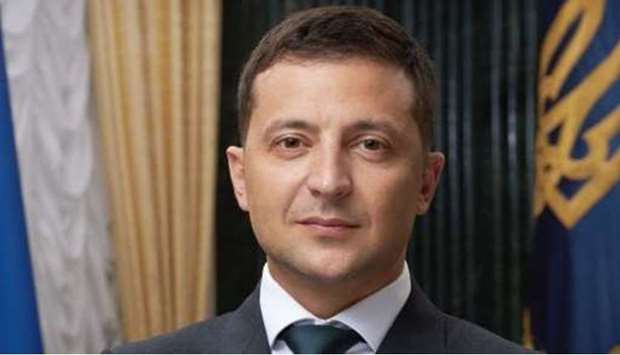
Ukraine's President Volodymyr Zelenskiy