


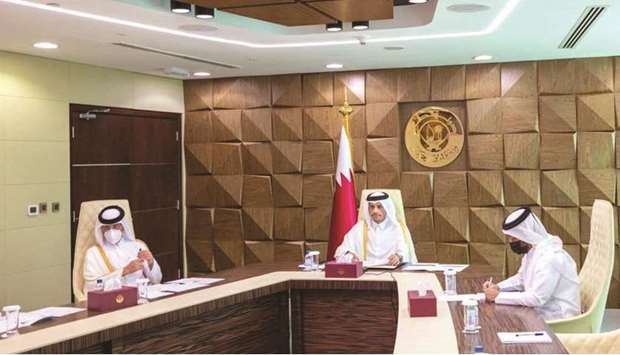
HE the Deputy Prime Minister and Minister of Foreign Affairs Sheikh Mohamed bin Abdulrahman al-Thani stressed that bilateral ties between Qatar and Japan are seeing great development and growth in various fields due to the mutual trust and political will on both sides to enhance co-operation. He said that the official visit His Highness the Amir Sheikh Tamim bin Hamad al-Thani paid to Tokyo in January 2019 represented a new phase of co-operation and the strategic partnership between the two sides.
This came during the 2nd Ministerial Arab-Japan Political Dialogue, which was held yesterday via videoconference. The Arab side was chaired by HE Sheikh Mohamed with League of Arab States Secretary-General Ahmed Abo al-Gheit. The Japanese side was chaired by Minister for Foreign Affairs of Japan Toshimitsu Motegi.
The FM said that the agreements signed between Qatar and the joint statement on establishing a mechanism for strategic dialogue, reflected the honest desire on both sides to enhance bilateral relations and encourage ongoing co-operation in all fields and added that, "Japan continues to be one of Qatar's most important trade partners, especially in the field of energy, after 50 years of establishing ties." He noted that Qatar is one of the primary LNG suppliers to Japan.
The Arab-Japanese ties are based on a long history of pursuing mutual interests, and it is filled with great examples of co-operation and shared viewpoints on a number of regional and international issues. The FM said that the Arab world is keen on enhancing and deepening that co-operation in different fields, and noted that co-operation between the Arab and Japanese sides saw great development over the past years, in addition to sharing similar viewpoints on a number of regional and international issues, particularly those related to international peace, disarmament, denuclearisation, countering terrorism, climate change, and reforming the United Nations and the Security Council among other topics.
The Arab-Japanese ties are not just based on political and strategic co-operation, but extends to the economic co-operation which has seen great growth, reflected in the large increase in the size of trade volume and investments.
The FM added that the Japanese role and support of Arab issues, led by the Palestinian issue is laudable, adding that the Arab side looks towards this support to continue as part of the efforts made by the international community to oblige Israel to adhere to international resolutions and peace based on a two-state solution, so that the Palestinian people can practice their right of establishing an independent state on the borders of June 4, 1967 with East Al Quds as its capital.
HE Sheikh Mohamed renewed appreciation to the Japanese support to United Nations Relief and Works Agency for Palestine Refugees in the Near East (UNRWA), expressing hope that the support would continue so that the agency can carry out its role of helping around 5mn Palestinian refugees who are suffering with difficult humanitarian conditions.
He said that, as part of Japan's active role in maintaining international peace and security, the Arab world hopes that Japan plays its part in participating in international community efforts in resolving Arab crises, led by the crises in Syria, Libya, and Yemen. He added that the meeting comes in extraordinary circumstances imposed by the coronavirus pandemic and the grave dangerous impact it has on the economy and society all over the world.
The FM added that there is no doubt that the pandemic has shown firsthand the importance of having all countries cooperate in facing joint challenges facing humanity and added that he looks forward to enhancing solidarity and co-operation between the Arab and Japanese side in containing the impact of the pandemic. HE the Deputy Prime Minister and Minister of Foreign Affairs expressed his hope that the meeting achieves its goals, and contributes to enhancing ties between both sides.
This came during the 2nd Ministerial Arab-Japan Political Dialogue, which was held yesterday via videoconference. The Arab side was chaired by HE Sheikh Mohamed with League of Arab States Secretary-General Ahmed Abo al-Gheit. The Japanese side was chaired by Minister for Foreign Affairs of Japan Toshimitsu Motegi.
The FM said that the agreements signed between Qatar and the joint statement on establishing a mechanism for strategic dialogue, reflected the honest desire on both sides to enhance bilateral relations and encourage ongoing co-operation in all fields and added that, "Japan continues to be one of Qatar's most important trade partners, especially in the field of energy, after 50 years of establishing ties." He noted that Qatar is one of the primary LNG suppliers to Japan.
The Arab-Japanese ties are based on a long history of pursuing mutual interests, and it is filled with great examples of co-operation and shared viewpoints on a number of regional and international issues. The FM said that the Arab world is keen on enhancing and deepening that co-operation in different fields, and noted that co-operation between the Arab and Japanese sides saw great development over the past years, in addition to sharing similar viewpoints on a number of regional and international issues, particularly those related to international peace, disarmament, denuclearisation, countering terrorism, climate change, and reforming the United Nations and the Security Council among other topics.
The Arab-Japanese ties are not just based on political and strategic co-operation, but extends to the economic co-operation which has seen great growth, reflected in the large increase in the size of trade volume and investments.
The FM added that the Japanese role and support of Arab issues, led by the Palestinian issue is laudable, adding that the Arab side looks towards this support to continue as part of the efforts made by the international community to oblige Israel to adhere to international resolutions and peace based on a two-state solution, so that the Palestinian people can practice their right of establishing an independent state on the borders of June 4, 1967 with East Al Quds as its capital.
HE Sheikh Mohamed renewed appreciation to the Japanese support to United Nations Relief and Works Agency for Palestine Refugees in the Near East (UNRWA), expressing hope that the support would continue so that the agency can carry out its role of helping around 5mn Palestinian refugees who are suffering with difficult humanitarian conditions.
He said that, as part of Japan's active role in maintaining international peace and security, the Arab world hopes that Japan plays its part in participating in international community efforts in resolving Arab crises, led by the crises in Syria, Libya, and Yemen. He added that the meeting comes in extraordinary circumstances imposed by the coronavirus pandemic and the grave dangerous impact it has on the economy and society all over the world.
The FM added that there is no doubt that the pandemic has shown firsthand the importance of having all countries cooperate in facing joint challenges facing humanity and added that he looks forward to enhancing solidarity and co-operation between the Arab and Japanese side in containing the impact of the pandemic. HE the Deputy Prime Minister and Minister of Foreign Affairs expressed his hope that the meeting achieves its goals, and contributes to enhancing ties between both sides.