


Guardian News Service /London
Britain could get its first taste of 4G this autumn after regulators approved an application by the company that owns the T-Mobile and Orange networks to launch the next generation of mobile internet on 11 September.

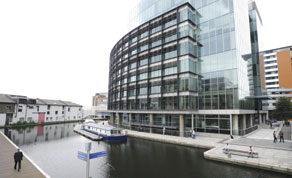
A general view of the building in Paddington, west London where the company Everything Everywhere holds offices in London yesterday
Telecoms watchdog Ofcom has granted Everything Everywhere (EE), Britain’s largest mobile company with 27mn customers, permission to launch 4G on its existing spectrum, without having to wait for the auction of British airwaves scheduled to conclude early next year.
Allowing EE to steal a march on rivals has already prompted an angry response from Vodafone, which said it was “frankly shocked” at Ofcom’s decision.
With the iPhone 5 rumoured to be unveiled on 12 September, EE could in theory launch its service the day before, although Ofcom said the timing was a coincidence.
It is expected that EE will use the arrival of 4G to launch a rebrand, following widespread criticism of the confusing parent company name and the decision to retain both the T-Mobile and Orange labels.
EE has been installing 4G radios on its masts since the beginning of the year and has already covered a number of major population centres. A spokeswoman said it was the company’s intention to begin selling 4G to consumers before the end of the year, although the exact date has yet to be confirmed. She said EE remained “committed” to its brands for the “foreseeable future”.
In its statement, Ofcom said varying EE’s licence to allow it to use its large holding of 1800MHz spectrum for 4G would “deliver significant benefits to consumers”, adding “there is no material risk that those benefits will be outweighed by a distortion of competition. Delaying doing so would therefore be to the detriment of consumers”.
The new technology is a successor to 3G, which allowed connections to the internet on mobile phones for the first time when it was introduced a decade ago. Networks are promising that 4G will bring even faster download speeds, helping networks keep up with the growing demand for data from smartphones. Faster speeds will allow more video streaming, email, mapping services and social networking sites over the networks.
In a week that is likely to see a significant reshaping of Britain’s mobile spectrum landscape, Everything Everywhere is also close to selling a chunk of its airwaves to Britain’s smallest operator, Three, owned by the Hong Kong conglomerate Hutchison Whampoa. The European commission had ordered EE to sell a quarter of its 1,800 holding as a condition of approving the T-Mobile/Orange merger .
Vodafone and O2 also bid for the spectrum, but it is thought they have missed out. The sale, arranged by EE’s financial adviser Morgan Stanley, would not necessarily allow Three to launch 4G this year. This is because EE is not obliged to clear the spectrum until September 2013.
Meanwhile, Vodafone and O2 say they will have to acquire more airwaves before being able to launch 4G. The forthcoming auction, which could raise 4.5bn for the public purse, will see a chunk of airwaves currently used for digital TV repurposed for mobile signals.
However, the process of clearing TV signals out of the bands will not complete until October 2013. Northern Ireland will be cleared by the end of this year, Wales by May 2013 and England and Scotland will be last.
“We believe this is a positive development for EE, giving it a temporary commercial advantage as it may be able to market ‘4G’ branded services ahead of the other UK mobile operators,” analysts at Espirito Santo bank said in a note.
“We understand the other operators may be able to appeal this decision but given Ofcom’s analysis we imagine the best they could hope for is a delay to when EE can repurpose this spectrum.”
Ofcom has confirmed that its decision could be appealed, although culture secretary Jeremy Hunt warned networks on Monday against using litigation to delay the arrival of 4G.
But Vodafone said in a statement: “We are frankly shocked that Ofcom has reached this decision. The regulator has shown a careless disregard for the best interests of consumers, businesses and the wider economy through its refusal to properly regard the competitive distortion created by allowing one operator to run services before the ground has been laid for a fully competitive 4G market.”
Three is unhappy with the design of the 4G auction, which it hoped would see it given more preferential treatment to ensure that its business remains viable. It is already the smallest network with 8m customers and has only just begun to make a profit.
In a statement, Three said allowing EE to go first “without addressing competition issues” could lead to “further distortion” in the UK market.
It is not known whether the latest Apple handset will support 4G on the 1,800Mhz band which EE will use to launch its service, although there have been reports that the Californian company is in negotiations with Asian networks to do just that.
EE said in a statement: “4G will drive investment, employment and innovation and we look forward to making it available later this year, delivering superfast mobile broadband to the UK.”