


Reuters/London
 |
|
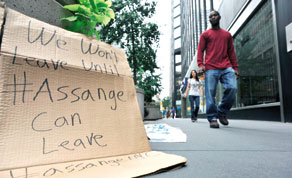
A sign placed by supporters of WikiLeaks founder Julian Assange outside the British Consulate in New York. |
Downing Street, the office of Prime Minister David Cameron, and the Home Office said attempts to disrupt the work of their sites had failed or caused minor problems, although the Ministry of Justice (MoJ) said the attack had affected its website.
The incident comes as Assange - who is trying to avoid extradition to Sweden where he is wanted for questioning over rape allegations - remains holed up in the Ecuadorean Embassy in London. He and Ecuador have criticised the British government for suggesting it might revoke the embassy’s diplomatic status in order to enter and arrest him.
“This is a public information website and no sensitive data is held on it. Measures put in place to keep the website running mean that some visitors may be unable to access the site intermittently,” an MoJ spokeswoman said.
Downing Street was dismissive of the incident.
“There may have been an attempt but as far as we are concerned it was unsuccessful,” a spokeswoman said.
All the websites appeared to be functioning normally yesterday. Anonymous, a loose-knit group of international hackers, suggested it was behind the attacks which it linked to the Assange case.
“Justice.gov.uk seems to be offline. Odd. #Anonymous #Assange,” said a posting on the group’s Twitter website at the time of the attacks on Monday night.
It later added: “Sorry for the delay Forgot to say no3 #TangoDown aprox 1 hour ago ;) number10.gov.uk/ #OpFreeAssange.”
Britain has said Assange will be arrested and deported if he emerges from the embassy after Ecuador granted him political asylum last week. He says he is the victim of a US-led witch-hunt over his whistle-blowing website.
Anonymous has carried out a number of attacks on British and international government departments, usually using a distributed denial of service tactic, where a website’s host computers are bombarded with requests for information, making them crash. It has also targeted companies it deems have worked against WikiLeaks’ interests including Visa and Mastercard.
The UK would be committing diplomatic suicide if it tried to enter his country’s embassy in London, Ecuadorean President Rafael Correa has said.
‘Such a move would open up the UK to having its diplomatic missions around the world entered,’ BBC quoted Correa as saying yesterday.
Assange has taken refuge in the embassy and been granted asylum by Ecuador as he fights extradition.
The UK says it is obliged to extradite him to Sweden, where he faces questioning over sex assault claims, which he denies, and he will be arrested if he leaves the embassy.
Assange entered the embassy in June while on bail before extradition proceedings against him started.