


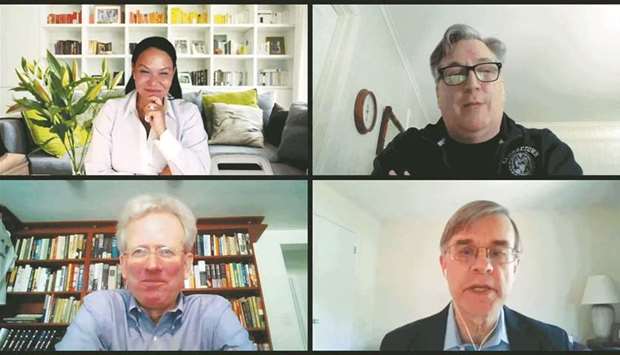
A total of 35 students took part in the annual Crisis Simulation diplomacy exercise at Georgetown University in Qatar (GU-Q), Qatar Foundation partner.
This allows participants to practise the intensive, multi-party negotiations required to reach an international agreement on how to resolve current issues facing the world today. This year’s scenario is a UN-led peace talk aimed at solving the ongoing conflict in Libya that has cost lives and created national and regional instability.
Negotiation simulations prompt students to engage in collaborative problem solving and teach valuable negotiation skills, said Dr Christine Schiwietz, GU-Q assistant dean for academic affairs and the programme organiser. “The simulation has students step into the shoes of key players facing a real diplomatic challenge, an unparalleled hands-on experiential learning activity. Students learn how to build coalitions in a multilateral context and learn the critical role mediators can play in global policy negotiations.”
The exercise is co-organised by James Seevers, director of studies at the Institute for the Study of Diplomacy (ISD) at Georgetown University in Washington, DC. Reflecting on this year’s first-ever virtual simulation with GU-Q, he said, “With a few modifications, we successfully adapted ISD’s negotiation simulations online. This change ensured a continuation of Georgetown’s diplomatic training activities, and is a reflection of the new demands facing diplomats in a pandemic, with global leaders also conducting some of their critical diplomatic work online.”
Set in the year 2022, this year’s scenario involved a United Nations Support Mission in Libya hosting another peace conference in an attempt to secure a long-term deal between the two main rival parties. Student teams representing the United States, Russia, Turkey, the United Arab Emirates, and the European Union also took on roles in the talks.
Students were given detailed information about the situation and their roles, and advisers with significant professional diplomatic experience provided expert guidance on how to determine national interests and negotiate for best possible outcomes.
For international politics major, Alak Raad, the experience drove home the complexity of compromise. "I learned that coming up with solutions through diplomacy is something that takes time. The voices involved seek to integrate their self-interested goals in this process, thereby neglecting the bigger picture of saving lives.”
Former US ambassador to Tunisia, Gordon Gray took on the role of the UN Special Representative. Expert advisers also included former US ambassador to Algeria, John Desrocher, and the director of the Brookings Doha Centre, Dr Tarik Yousef.
ISD State Department Rusk Fellow, Hammad Hammad, ISD case studies and publications editor, Alistair Somerville, and ISD research assistant, Jonas Heering created the simulation materials and co-ordinated the exercise.