


 |
Clegg confirmed that he and all other Liberal Democrat ministers would vote down legislation to cut the number of MPs in the House of Commons to 600 – a move that makes it significantly less likely that the Tories will be able to win an outright majority at next election.
Normally if a minister defied the government whip they would be forced to resign. The mass resignation of Liberal Democrat ministers would cause the collapse of the government and likely spark an early election.
Downing Street appeared to accept the boundary change rebellion to avoid such a prospect.
Privately, some senior Liberal Democrats are not unhappy at the outcome – even if it means losing Lords reform.
The party stood to lose up to 14 of their 57 MPs as a result of the boundary changes and feared that a protracted and acrimonious row over House of Lords reform at time of economic crisis would play badly with voters.
“Only some of our more intellectually isolated supporters really cared that much about Lords reform,” said one.
Conservative backbenchers – whose rebellion over Lords reform led to Monday’s announcement and would proportionally lose far fewer seats as a consequence of boundary changes – were less sanguine.
“Apart from keeping ministers in office, what is the coalition now for?” asked the Tory MP Douglas Carswell. “What we need is a new coalition agreement which is not done in a rush by a clique and that can be democratically agreed by our party conferences.”
Another Tory MP added: “This will go down like a lead balloon. Nick Clegg is on the record supporting boundary changes and now he’s suddenly changed his mind because he hasn’t got House of Lords Reform. He’s basically throwing his toys out of the pram.”
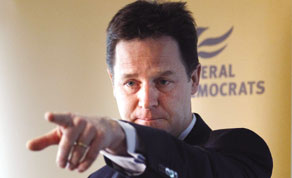
In a press conference formally announcing the end of legislation to create an elected second chamber, Clegg said that he had been prepared to put the changes to a referendum. But this offer was blocked by Cameron because the deal would also have delayed boundary changes from coming into force until 2020.
Clegg said as a consequence the Liberal Democrats had no choice but to oppose boundary changes – laying the blame firmly at the door of Conservative backbenchers who defied to whip to oppose Lords reform.
“The Conservative party is not honouring the commitment to Lords reform and, as a result, part of our contract has now been broken,” he said. “Clearly I cannot permit a situation where Conservative rebels can pick and choose the parts of the contract they like, while Liberal Democrat MPs are bound to the entire agreement.
“Coalition works on mutual respect; it is a reciprocal arrangement, a two-way street. So I have told the prime minister that when, in due course, parliament votes on boundary changes for the 2015 election I will be instructing my party to oppose them.”