


About 93mn years ago, a bizarre plankton-eating shark shaped unlike any other known marine creature glided through the sea in what is now northeastern Mexico using curiously elongated wing-like fins that rendered its body wider than it was long.
Scientists announced yesterday the discovery of a nearly complete fossil of the shark, called Aquilolamna milarcae, that lived during the Cretaceous Period at a time when dinosaurs ruled the land.
Its unusual proportions – a fin span of about 6-1/4 feet (1.9m) and a length from head to tail of about 5-1/2 feet (1.65m) – left the scientists amazed.
Aquilolamna’s name means “eagle shark”, a nod to its slender pectoral fins, which “mainly acted as an effective stabiliser”, according to vertebrate paleontologist Romain Vullo, lead author of the study published in the journal Science.
“Many adjectives can be used to describe this shark: unusual, unique, extraordinary, bizarre, weird. Yes, it is the only shark that is wider than long,” said Vullo, affiliated with Geosciences Rennes, a research unit involving the University of Rennes and France’s National Centre for Scientific Research.
Like all sharks and the related skates and rays, Aquilolamna had a cartilaginous skeleton.
It had the familiar torpedo-shaped body and tail of a shark but its pectoral fins were utterly unique.
The researchers said Aquilolamna appears to have been a slow-swimming shark that fed on plankton through filter-feeding, as plankton-eating whale sharks and basking sharks do today.
The fossil, unearthed in Mexico’s state of Nuevo Leon, did not reveal Aquilolamna’s filter mechanism for eating.
Rays such as the manta ray, with their flattened bodies and large pectoral fins fused all the way to the head, swim through the water as if they are flying through the air.
Aquilolamna appears to have done something similar.
“Whereas the locomotion of manta rays is like underwater flight, with flapping movements of their powerful pectoral fins, the long slender pectoral fins of Aquilolamna rather acted as the wings of a glider, or sailplane,” Vullo said.
Aquilolamna lived in the open ocean at a time when the seas were populated with marine reptiles, squid relatives with large shells called ammonites, various bony fishes, and large sharks.
The fish group that includes sharks appeared roughly 380mn years ago, long before the dinosaurs.
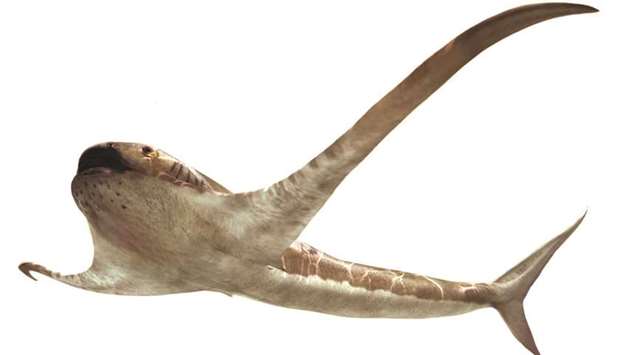
A handout image made available yesterday shows a rendition of Aquilolamna Eagle Shark.