


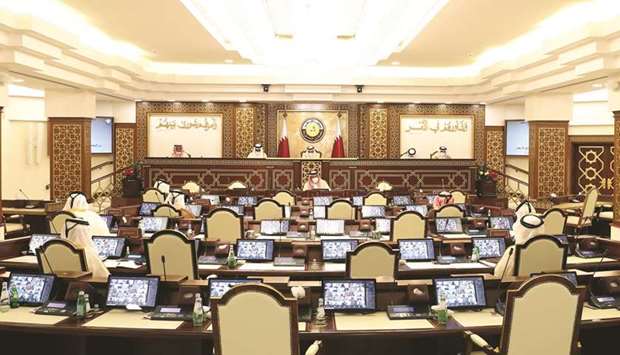
The Shura Council held its weekly meeting via videoconferencing under the chairmanship of HE the Speaker Ahmed bin Abdullah bin Zaid al-Mahmoud, at the Council's headquarters on Monday.
The session was attended by HE the President of the Planning and Statistics Authority, Dr Saleh bin Mohamed al-Nabit, on an invitation from HE the Speaker to brief the Council on the State's efforts regarding Qatar National Vision 2030 and the challenges it faces.
HE Speaker Ahmed bin Abdullah bin Zaid Al Mahmoud said that Qatar National Vision 2030 is a road map for the future and constitutes a platform for action by which the State will be enlightened in its development in various fields during the coming decades so that Qatar's citizens and residents benefit from its development.
His Excellency indicated that HH the Amir Sheikh Tamim bin Hamad Al-Thani summarized this vision in an introduction in 2008, in which His Highness said, "Qatar National Vision 2030 builds a bridge between the present and the future.
It envisages a vibrant and prosperous country in which there is economic and social justice for all, and in which nature and man are in harmony.
We need to galvanize our collective energies and direct them toward these aspirations.
Strong Islamic and family values will provide our moral and ethical compass."
His Excellency expressed the Council's appreciation for the role of the Planning and Statistics Authority and before it the General Secretariat for Development Planning in preparing the first and second National Development Strategies and setting the necessary mechanisms to monitor and follow up on them in order to convert the goals of Qatar National Vision into a tangible reality in the country.
He stressed the importance of an effective mechanism to attract qualified national human cadres and create an attractive work environment for them in the field of planning and strategies, the role of the private sector and the role of the Qatari citizen in implementing the strategy, taking into account the specificity of the Qatari society, its heritage and culture.
His Excellency explained that the invitation of HE President of the Planning and Statistics Authority comes to learn about the features of the current strategy and its objectives, especially the short-term goals that enable the people of Qatar to see their results in their daily lives within a short period, and the nature of guarantees that will make the strategy bear fruit in the short, medium and long term.
It also comes within the framework of the Council's contribution to the reform and development process that the country is going through and keeping pace with the development plans, foremost of which is Qatar National Vision 2030 in a way that ensures concerted efforts in an integrative work aimed at achieving the vision led by HH the Amir Sheikh Tamim bin Hamad Al-Thani.
HE the Speaker of the Shura Council welcomed HE the President of the Planning and Statistics Authority and invited him to speak to the members of the Council, listen to their views and respond to their questions and inquiries.
HE the President of the Planning and Statistics Authority gave a comprehensive presentation on Qatar National Vision 2030 in its various fields, objectives, foundations, and principles guiding it, the State's efforts in implementing it, and the challenges it faces.
In response to the questions and inquiries of the Council members, HE clarified that important achievements have been made through the First National Development Strategy 2011-2016 and the Second National Development Strategy 2018-2022, while the development of the third national development strategy which aims to achieve a higher level of economic progress, development and population stability has begun.
He said that the challenges facing the implementation of the Qatar National Vision 2030 have become less severe after drawing up plans to confront them.
HE affirmed that paying attention to infrastructure had preceded Qatar's win in hosting the World Cup, and that this attention would continue after the World Cup, stressing that the country will be on the cusp of a new phase after 2022, and the focus will be on efficient use of resources, the provision of services and jobs for citizens, increasing the efficiency and productivity of the Qatari citizen and increasing interest in knowledge economies.
Regarding the demographics of the State of Qatar, HE the President of the Planning and Statistics Authority explained that there are good indicators as the number of expatriate workers has decreased, especially in the category of unskilled workers.
Following the comprehensive presentation made by HE Dr.
Saleh bin Mohammad Al Nabit and his response to the questions and inquiries of the members, extensive discussions took place on Qatar National Vision 2030, its future prospects and the progress of its implementation.
The interventions of the Speaker and members of the Shura Council focused on the need to pay attention to development projects, the areas outside Doha, developing education and health services, addressing social issues, paying attention to cultural affairs, preserving the environment and diversifying sources of income.
The interventions also focused on the post-World Cup 2022 phase, the demographics, and the need to keep citizens informed of what is being implemented of the Qatar National Vision 2030, first hand.
At the conclusion of the discussions, HE Speaker of the Shura Council thanked HE President of the Planning and Statistics Authority, expressing the council's appreciation for the role the Authority plays in serving the nation, developing the economy and effectively contributing to the country's developmental growth on the basis of studied scientific principles, sound planning and a comprehensive future vision.
For his part, HE Dr Saleh bin Mohamed Al Nabit praised the fruitful discussions, constructive opinions and useful proposals that were put forward during the session, stressing that the Planning and Statistics Authority will give it the appreciation and attention it deserves.
The session was attended by HE the President of the Planning and Statistics Authority, Dr Saleh bin Mohamed al-Nabit, on an invitation from HE the Speaker to brief the Council on the State's efforts regarding Qatar National Vision 2030 and the challenges it faces.
HE Speaker Ahmed bin Abdullah bin Zaid Al Mahmoud said that Qatar National Vision 2030 is a road map for the future and constitutes a platform for action by which the State will be enlightened in its development in various fields during the coming decades so that Qatar's citizens and residents benefit from its development.
His Excellency indicated that HH the Amir Sheikh Tamim bin Hamad Al-Thani summarized this vision in an introduction in 2008, in which His Highness said, "Qatar National Vision 2030 builds a bridge between the present and the future.
It envisages a vibrant and prosperous country in which there is economic and social justice for all, and in which nature and man are in harmony.
We need to galvanize our collective energies and direct them toward these aspirations.
Strong Islamic and family values will provide our moral and ethical compass."
His Excellency expressed the Council's appreciation for the role of the Planning and Statistics Authority and before it the General Secretariat for Development Planning in preparing the first and second National Development Strategies and setting the necessary mechanisms to monitor and follow up on them in order to convert the goals of Qatar National Vision into a tangible reality in the country.
He stressed the importance of an effective mechanism to attract qualified national human cadres and create an attractive work environment for them in the field of planning and strategies, the role of the private sector and the role of the Qatari citizen in implementing the strategy, taking into account the specificity of the Qatari society, its heritage and culture.
His Excellency explained that the invitation of HE President of the Planning and Statistics Authority comes to learn about the features of the current strategy and its objectives, especially the short-term goals that enable the people of Qatar to see their results in their daily lives within a short period, and the nature of guarantees that will make the strategy bear fruit in the short, medium and long term.
It also comes within the framework of the Council's contribution to the reform and development process that the country is going through and keeping pace with the development plans, foremost of which is Qatar National Vision 2030 in a way that ensures concerted efforts in an integrative work aimed at achieving the vision led by HH the Amir Sheikh Tamim bin Hamad Al-Thani.
HE the Speaker of the Shura Council welcomed HE the President of the Planning and Statistics Authority and invited him to speak to the members of the Council, listen to their views and respond to their questions and inquiries.
HE the President of the Planning and Statistics Authority gave a comprehensive presentation on Qatar National Vision 2030 in its various fields, objectives, foundations, and principles guiding it, the State's efforts in implementing it, and the challenges it faces.
In response to the questions and inquiries of the Council members, HE clarified that important achievements have been made through the First National Development Strategy 2011-2016 and the Second National Development Strategy 2018-2022, while the development of the third national development strategy which aims to achieve a higher level of economic progress, development and population stability has begun.
He said that the challenges facing the implementation of the Qatar National Vision 2030 have become less severe after drawing up plans to confront them.
HE affirmed that paying attention to infrastructure had preceded Qatar's win in hosting the World Cup, and that this attention would continue after the World Cup, stressing that the country will be on the cusp of a new phase after 2022, and the focus will be on efficient use of resources, the provision of services and jobs for citizens, increasing the efficiency and productivity of the Qatari citizen and increasing interest in knowledge economies.
Regarding the demographics of the State of Qatar, HE the President of the Planning and Statistics Authority explained that there are good indicators as the number of expatriate workers has decreased, especially in the category of unskilled workers.
Following the comprehensive presentation made by HE Dr.
Saleh bin Mohammad Al Nabit and his response to the questions and inquiries of the members, extensive discussions took place on Qatar National Vision 2030, its future prospects and the progress of its implementation.
The interventions of the Speaker and members of the Shura Council focused on the need to pay attention to development projects, the areas outside Doha, developing education and health services, addressing social issues, paying attention to cultural affairs, preserving the environment and diversifying sources of income.
The interventions also focused on the post-World Cup 2022 phase, the demographics, and the need to keep citizens informed of what is being implemented of the Qatar National Vision 2030, first hand.
At the conclusion of the discussions, HE Speaker of the Shura Council thanked HE President of the Planning and Statistics Authority, expressing the council's appreciation for the role the Authority plays in serving the nation, developing the economy and effectively contributing to the country's developmental growth on the basis of studied scientific principles, sound planning and a comprehensive future vision.
For his part, HE Dr Saleh bin Mohamed Al Nabit praised the fruitful discussions, constructive opinions and useful proposals that were put forward during the session, stressing that the Planning and Statistics Authority will give it the appreciation and attention it deserves.