


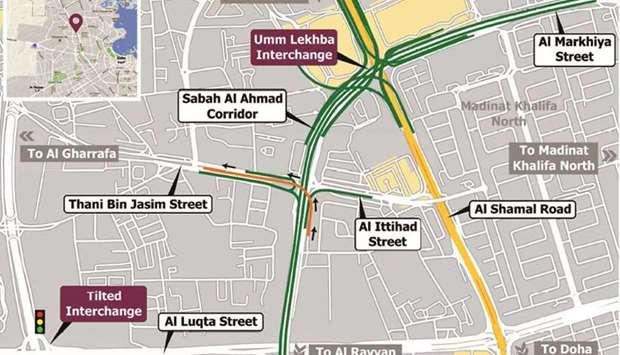
The Public Works Authority (Ashghal) will open a new bridge on the Sabah Al Ahmad Corridor at the Umm Lekhba Interchange (Landmark) on Friday.
Ashghal tweeted on Thursday that the 500m-long bridge would provide free-flowing traffic for road users travelling from Al Rayyan and Al Luqta towards Thani Bin Jassim Street and Al Gharrafa, bypassing the signalised junction under the flyover to cut travel time.
The bridge consists of two lanes in one direction to accommodate about 4,000 vehicles per hour, enhancing traffic movement in the area, especially for those coming from Al Luqta Tunnel or Khalifa Street.
Ashghal has said that the opening of the new bridge is part of the remaining sections of the Sabah Al Ahmad Corridor, as announced before, which will open in succession in co-ordination with the General Directorate of Traffic.
Earlier, Ashghal opened the highest and seventh bridge of the Umm Lekhba Interchange to provide free-flowing traffic for road users coming from Al Shamal Road towards Al Markhiya Street, along with pedestrian and bicycle paths and beautification elements on the east side of the new Al Hatim Street in Al Gharrafa area.
The Umm Lekhba Interchange consists of four levels and nine bridges that provide free traffic flow in all directions.
It can accommodate more than 20,000 vehicles per hour.
Five bridges consist of two lanes in one direction, while the remaining four bridges has one lane for each direction.
It is the second highest interchange in Qatar after the Umm Besher Interchange on G-Ring Road.
The Umm Lekhba Interchange is considered to be the northern gateway of Doha and a “distribution station” due to its strategic location, where Al Shamal Road intersects with the Doha Expressway, Al Markhiya Street and the Sabah Al Ahmad Corridor, and witnesses heavy traffic to and from Doha via Al Shamal.
The Umm Lekhba Interchange will ease traffic congestion on Doha Expressway, especially at the Al Gharrafa (Immigration) interchange and Al Duhail intersection.
It will also ensure smooth traffic flow for those coming from the Doha Corniche, Markhiya, Madinat Khalifa and Duhail in the direction of Al Shamal Road, the Sabah Al Ahmad Corridor, Al Gharrafa and the Gharrafat Al Rayyan areas to Al Luqta and Al Rayyan.
The bridge consists of two lanes in one direction to accommodate about 4,000 vehicles per hour, enhancing traffic movement in the area, especially for those coming from Al Luqta Tunnel or Khalifa Street.
Ashghal has said that the opening of the new bridge is part of the remaining sections of the Sabah Al Ahmad Corridor, as announced before, which will open in succession in co-ordination with the General Directorate of Traffic.
Earlier, Ashghal opened the highest and seventh bridge of the Umm Lekhba Interchange to provide free-flowing traffic for road users coming from Al Shamal Road towards Al Markhiya Street, along with pedestrian and bicycle paths and beautification elements on the east side of the new Al Hatim Street in Al Gharrafa area.
The Umm Lekhba Interchange consists of four levels and nine bridges that provide free traffic flow in all directions.
It can accommodate more than 20,000 vehicles per hour.
Five bridges consist of two lanes in one direction, while the remaining four bridges has one lane for each direction.
It is the second highest interchange in Qatar after the Umm Besher Interchange on G-Ring Road.
The Umm Lekhba Interchange is considered to be the northern gateway of Doha and a “distribution station” due to its strategic location, where Al Shamal Road intersects with the Doha Expressway, Al Markhiya Street and the Sabah Al Ahmad Corridor, and witnesses heavy traffic to and from Doha via Al Shamal.
The Umm Lekhba Interchange will ease traffic congestion on Doha Expressway, especially at the Al Gharrafa (Immigration) interchange and Al Duhail intersection.
It will also ensure smooth traffic flow for those coming from the Doha Corniche, Markhiya, Madinat Khalifa and Duhail in the direction of Al Shamal Road, the Sabah Al Ahmad Corridor, Al Gharrafa and the Gharrafat Al Rayyan areas to Al Luqta and Al Rayyan.