


 |
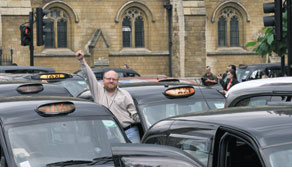
| A taxi driver protests along with scores of others in Parliament Square, London, against traffic rules restricting the use of Olympic Lanes during the Games |
G4S has been at the centre of a political firestorm, and has lost about £650mn in market value, since it announced it could not provide the promised 10,400 Olympic security guards just two weeks before the Games.
Shares in the group fell another 6% as chief executive Nick Buckles appeared before a hostile parliamentary committee, struggling to answer several questions.
At one point he got so tied up that he said “I don’t know whether I’m speaking fluent English now”, when asked about the language skills of his Olympic staff.
The embarrassing staffing admission has ignited a row over the government’s decision to outsource key work to the private sector and left ministers from the prime minister down trying to explain how the failure was allowed to develop.
“Many would take the view that the reputation of the company is in tatters” Buckles was told by one member of the influential home affairs select committee after being summoned at short notice to explain the debacle.
“I think at the moment I would have to agree with you,” Buckles said, looking uncomfortable and sitting ramrod straight before lawmakers in an ornate wood-panelled room.
“We have had a fantastic track record of service delivery over many years in many countries but clearly this is not a good position to be in,” he said, adding that the group would still take its £57mn management fee.
The debacle has sparked damning headlines around the world just 10 days before the world’s biggest sporting event begins and revived previous embarrassments from the firm’s history, such as a string of prisoner escapes and riots.
Last year the group left prisoners locked up for almost 24 hours at a jail after losing the keys to cells. In another incident, guards tagged a man’s false leg, allowing him to remove it and break a court-imposed curfew.
“Certainly my view, and the view of the board, is I’m the best person at the moment to take this through,” said Buckles, who stands out among other FTSE CEOs for his thick, wavy hair and fashionable black-rimmed glasses.
To fill the gap left by G4S, the government has called up an additional 3,500 soldiers, many of whom had just returned from lengthy deployments in Afghanistan.
On Monday it emerged that, as well as extra troops, nine police forces had also been called on to help man venues after some G4S staff failed to show up to work.
The row is a blow for Buckles, who describes himself as a no-nonsense, no-excuses type of CEO who prefers running marathons and supporting the West Ham soccer team to reading books. “Clearly we regret signing the contract but now we have to get on and deliver it,” the 27-year G4S veteran said, after being asked at one point to speak up and answer questions more directly.
Just 11 days ago, the managing director of G4S Global Events, Ian Horseman Sewell, said the company was so confident about the Olympics that it believed it could stage another similar-sized event at the same time if needed, a line that was repeated numerous times at the committee hearing.
Buckles said G4S would seek to compensate the police and consider a bonus for police and troops, prompting the chairman of the committee to ask if he was making up plans on the spot.
Thousands waiting for security vetting
Security firm G4S was caught in a new fiasco yesterday as it emerged thousands of staff still have to be vetted. The guards are waiting for the company to complete lengthy screening procedures so they can start work at Games sites across the country. G4S does its own security screening before applicants are trained. Separate screening is then carried out by Locog and the Home Office. Potential G4S recruits took to internet forums yesterday to express their frustration at the firm’s vetting system. One wrote: “I still do not have my uniform or schedule with 11 days to go.” A G4S spokesman admitted that thousands were still going through the company’s vetting process, but insisted: “It was always going to be a phased delivery programme.”