


Nasa’s science rover Perseverance, the most advanced astrobiology laboratory ever sent to another world, streaked through the Martian atmosphere yesterday and landed safely on the floor of a vast crater, its first stop on a search for traces of ancient microbial life on the Red Planet.
Mission managers at the National Aeronautics and Space Administration (Nasa)’s Jet Propulsion Laboratory near Los Angeles burst into applause and cheers as radio signals confirmed that the six-wheeled rover had survived its perilous descent and arrived within its target zone inside Jezero Crater, site of a long-vanished Martian lake bed.
The robotic vehicle sailed through space for nearly seven months, covering 293mn miles (472mn km) before piercing the Martian atmosphere at 12,000mph (19,000kph) to begin its approach to touchdown on the planet’s surface.
The spacecraft’s self-guided descent and landing during a complex series of manoeuvres that Nasa dubbed “the seven minutes of terror” stands as the most elaborate and challenging feat in the annals of robotic spaceflight.
“It really is the beginning of a new era,” Nasa’s associate administrator for science, Thomas Zurbuchen, said earlier in the day during Nasa’s webcast of the event.
The landing represented the riskiest part of two-year, $2.7bn endeavour whose primary aim is to search for possible fossilised signs of microbes that may have flourished on Mars some 3bn years ago, when the fourth planet from the sun was warmer, wetter and potentially hospitable to life.
Scientists hope to find biosignatures embedded in samples of ancient sediments that Perseverance is designed to extract from Martian rock for future analysis back on Earth – the first such specimens ever collected by humankind from another planet.
Two subsequent Mars missions are planned to retrieve the samples and return them to Nasa in the next decade.
Nasa scientists have described Perseverance as the most ambitious of nearly 20 US missions to Mars dating back to the Mariner spacecraft’s 1965 fly-by.
Larger and packed with more instruments than the four Mars rovers preceding it, Perseverance is set to build on previous findings that liquid water once flowed on the Martian surface and that carbon and other minerals altered by water and considered precursors to the evolution of life were present.
Perseverance’s payload includes demonstration projects that could help pave the way for eventual human exploration of Mars, including a device to convert the carbon dioxide in the Martian atmosphere into pure oxygen.
The box-shaped tool, the first built to extract a natural resource of direct use to humans from an extraterrestrial environment, could prove invaluable for future human life support on Mars and for producing rocket propellant to fly astronauts home.
Another experimental prototype carried by Perseverance is a miniature helicopter designed to test the first powered, controlled flight of an aircraft on another planet.
If successful, the 4-pound (1.8-kg) helicopter could lead to low-altitude aerial surveillance of distant worlds, officials said.
Perseverance’s immediate predecessor, the rover Curiosity, landed in 2012 and remains in operation, as does the stationary lander InSight, which arrived in 2018 to study the deep interior of Mars.
Last week, separate probes launched by the United Arab Emirates and China reached Martian orbit.
Nasa has three Mars satellites still in orbit, along with two from the European Space Agency.
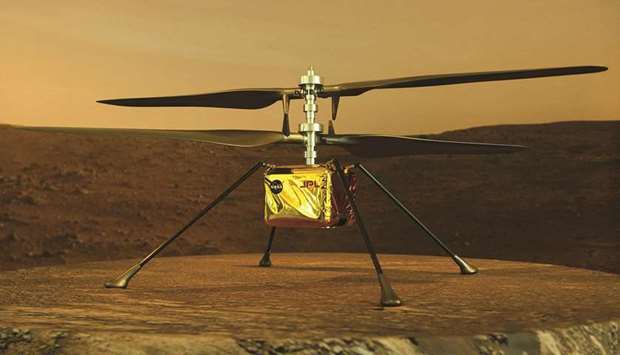
A full-scale model of the experimental Ingenuity Mars Helicopter, which will be carried under the Perseverance rover.