


Britain yesterday closed in on a mid-February target to offer coronavirus vaccinations to 15mn of its most vulnerable people, raising hopes that a grinding lockdown could be eased.
More than 13.5mn people have been given a jab since the world-first immunisation programme began in early December, with a daily average of 431,232 receiving a vaccine last week.
Prime Minister Boris Johnson has vowed to offer jabs to all top four priority groups — which includes over-70s, care home residents and some key workers — by the end of this week.
The devolved government in Wales, which controls its own health policy, said it had reached the target of vaccinating the top four categories yesterday.
Figures show nearly 22% of people in Wales have at least received a first jab, compared to 20.3% in England, 19.2 % in Scotland and 18.7% in Northern Ireland. First Minister Mark Drakeford hailed hitting the “milestone” but said the nation was not in a competition with the rest of the UK or other countries.
“The race is to get as many people vaccinated as fast as we can so that we can begin to see this dreadful experience in the rearview mirror,” he added.
The UK government in London, which is responsible for sourcing vaccines, is next aiming to have offered jabs to all over-50s by May and the entire adult population by September.
Infection rates have dropped markedly across Britain over recent weeks, as strict lockdown measures have curbed previously spiralling case numbers, hospitalisations and deaths.
The Office for National Statistics’ latest infection survey released yesterday showed new cases decreasing in nearly every region of England, where it estimates around one in 80 people had the virus last week.
In early January it was as high as one in 50. Meanwhile the virus’ reproduction rate, the so-called “R value”, has fallen to between 0.7 and 0.9 — the first time it has dropped below 1 since last July.
That means on average, every 10 people infected will infect between seven and nine others.
The improving situation has prompted calls for the stay-at-home rules to be lifted in early March, despite concern about the spread of virus variants that may be more resistant to vaccines.
A new 10-day hotel quarantine regime for British residents returning from 33 virus variant hotspots begins on Monday, despite criticism is too little, too late.
Johnson has vowed to review all relevant data next week, ahead of setting out the government’s “roadmap” for the months ahead on February 22.
“We will set out a gradual and phased approach towards easing the restrictions in a sustainable way,” his spokesman told reporters, noting it would include plans “for reopening schools and gradually reopening our economy and society”. But he added Britain remained “in a difficult situation” with its state-run health service still under very significant pressure.
Epidemiologist Neil Ferguson, one of the government’s most high-profile scientific advisers, said the country was now “in a better place than I might have anticipated a month ago”. Johnson will “have some bandwidth” to start reopening primary schools in early March before potentially easing other restrictions the following month, he said.
But Ferguson cautioned against moving too hastily. “If we relax too quickly without seeing the effect of each stage of relaxation, we may do what we’ve done before and relax too much, see a surge in case numbers, and still need to tighten up measures again,” he told Politico’s “Westminster Insider” podcast.
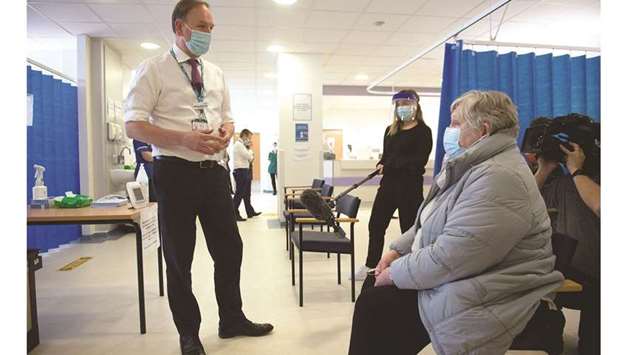
Chief Executive of the National Health Service in England, Sir Simon Stevens speaks to patients during a visit to a Covid-19 vaccination clinic at University Hospital Coventry in the Walsgrave on Sowe area of Coventry, West Midlands yesterday.