


The Biden administration has launched a formal review of the future of the US military prison at Guantanamo Bay in Cuba with the goal of reviving efforts to close the controversial facility, a White House official said yesterday.
Aides involved in internal discussions are considering an executive action to be signed by President Joe Biden in the coming weeks or months, two people familiar with the matter told Reuters, signalling a new effort to remove what human rights advocates have called a stain on America’s global image.
“We are undertaking an NSC process to assess the current state of play that the Biden administration has inherited from the previous administration, in line with our broader goal of closing Guantanamo,” National Security Council spokeswoman Emily Horne told Reuters.
“The NSC will work closely with the departments of defence, state, and justice to make progress toward closing the GTMO facility, and also in close consultation with Congress,” she added.
Such an initiative, however, is unlikely to bring down the curtain anytime soon on the high-security facility located at the Guantanamo Naval Station.
Set up to house foreign suspects following the September 11, 2001, attacks on New York and Washington, the facility came to symbolise the excesses of the US “war on terror” because of harsh interrogation methods that critics say amounted to torture.
The immediate impact, however, could be to reinstate, in some form, the Guantanamo closure policy of Biden’s old boss, former president Barack Obama, which was reversed by Donald Trump as soon as he took office in 2017.
Trump kept the offshore prison open during his four years in the White House - though he never loaded it up with “bad dudes,” as he once vowed.
Now, 40 prisoners remain, most held for nearly two decades without being charged or tried.
Biden’s campaign said during the 2020 race that he continued to support closing the detention centre but did not say how he would do it.
It is also unclear how specific Biden’s coming executive action might be about his plans for the prison, which holds suspects in the September 11 attacks among its detainee population.
Signalling that the process is still at an early stage, Horne said “a number of key policy roles still need to be filled within the interagency, including confirming sub-Cabinet policy roles at the defence, state, and justice departments.”
“There will be a robust interagency process to move forward on this but we need to have the right people seated to do this important work,” she said.
Biden, who was Obama’s vice president, can expect to face many of the same steep political, legal and diplomatic obstacles that frustrated his former boss.
Former president George W Bush opened the prison and its population grew to a peak of about 800 inmates before it started to shrink.
Obama whittled down the number further but his effort to close the prison was stymied largely by Republican opposition in Congress.
The federal government is still barred by law from transferring any inmates to prisons on the US mainland.
Even with his own Democratic party now controlling Congress, their majorities are so slim that Biden would face a tough challenge securing legislative changes because some Democrats might also oppose them.
A revived Guantanamo strategy is expected to focus initially on further decreasing the number of prisoners by repatriating them or finding other countries to accept them, according to the people familiar with the matter.
This could also mean re-establishing a state department post of Guantanamo closure envoy, created by Obama but eliminated by Trump, to resume negotiations with other governments on detainee transfers, the sources said.
In addition, the Pentagon could restart a parole-style review process of prisoners’ cases to determine whether they still posed a threat, the sources said.
Still, any Guantanamo-closing plan could initially be hampered by the coronavirus pandemic, which would make moving prisoners unlikely for now.
The Biden administration has not made Guantanamo one of its top early priorities as it grapples with the pandemic and its economic fallout at home and global challenges such as China, Russia, Iran and Myanmar.
In contrast, Obama made the closing of Guantanamo one of his first executive orders in 2009 but failed to achieve that goal by the end of his second term.
Shutting the facility has been a longtime demand of progressive Democrats whose support helped Biden win the White House in November.
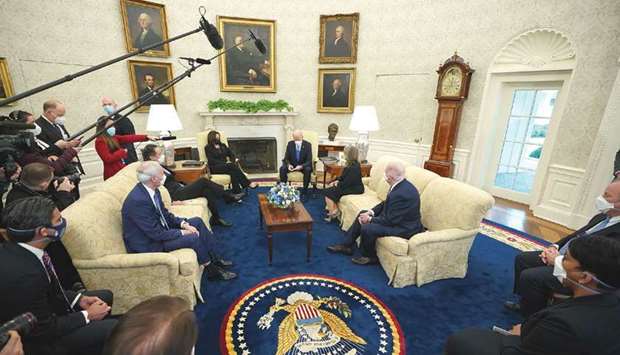
US President Joe Biden and Vice President Kamala Harris meet with governors and mayors on his Covid-19 relief plan, in the Oval Office of the White House in Washington, DC yesterday.