


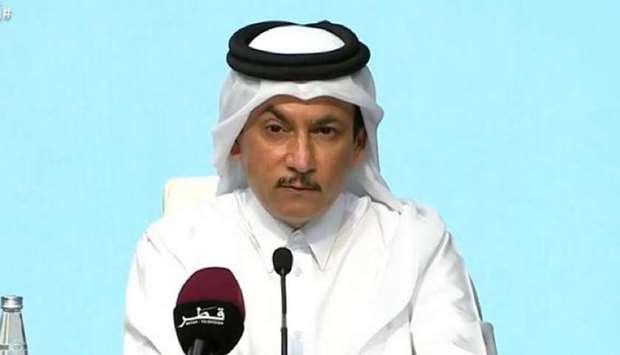
It is more important than ever to observe the preventive and precautionary measures against Covid-19 as Qatar is expected to witness an increase in infections over the coming weeks, a senior official urged on Wednesday.
"Covid-19 is constantly mutating and it is possible that the two variants spotted in the UK and South Africa may have reached Qatar," explained Dr Abdullatif al-Khal, chair of the National Health Strategic Group on Covid-19 and head of Infectious Diseases at Hamad Medical Corporation.
Though Qatar had managed to stabilise the pandemic, more cases have been registered over the recent weeks indicating a possible second wave of Covid-19, he told the press conference organised by the Supreme Committee for Crisis Management and aired on Qatar TV.
"The Cabinet has decided to reimpose some restrictions to curb the spread of Covid-19 in the country and avoid any possible spread of the new strains of the virus," the official observed while pointing out that the new variants are expected to cause more than 70-80% of the new infections in the countries where they already reached.
"All the six indicators of Covid-19 are increasing in Qatar over the past three weeks due to social gatherings. It is worrying that the number of critical cases that need hospitalisation are increasing, putting pressure on the healthcare facilities. The magnitude of the second wave (of infections) is not yet clear.
"Most of the restrictions announced by the Cabinet come under the second tier of four levels, with the last one being a complete lockdown. Daily rates of testing increased by 3.4%, which is double the rate two weeks ago.
"Even though the Covid-19 vaccine is effective, it is still important to maintain the preventive and precautionary measures.
"Wear face masks all the time outside the house, maintain social distancing, avoid crowds. The elderly and those with chronic diseases should limit their going out of home.
"Though a limited number of cases of Covid-19 have been spotted at schools, most of these came from outside the schools. So, it has been decided to maintain the current system of school attendance."
Dr al-Khal stressed that taking the Covid-19 vaccine currently does not exempt the person from abiding by the preventive and precautionary measures.
"It is possible to spread infection even though the vaccine is very effective. Until the majority of the population of Qatar takes the vaccine, the measures must be followed. It is also advisable to avoid travel unless it is necessary as the virus is spreading in many countries," he said.
In the light of the Covid-19 scenario, Dr al-Khal also suggested it is better to apply around six weeks ahead to the Ministry of Public Health for permission to hold events.
The MoPH relies on six main indicators to monitor the extent of the pandemic, which are the main factors in making decisions to impose or lift restrictions, Qatar News Agency (QNA) reported.
He explained that these decisions include the general rate of positive daily examinations, the rate of positive examination in random surveys, the number of daily severe infections that are hospitalised, the number of daily critical cases that are admitted to intensive care units, the cumulative rate of infection for 14 days in every 100,000 people, and the reproduction rate, QNA added.
These indicators are monitored to predict the possibility of a new wave of the pandemic, with the MoPH recommends the reimposition of some restrictions to prevent this from happening. These indicators are monitored every two weeks to decide whether to move to the next level, stay at the same level or return to the previous level, Dr al-Khal said, adding that this depends greatly on the commitment of community members and their adherence to the stipulated measures.
He said the number of critical cases requiring admission to intensive care has also increased, which may lead to an increase in deaths, indicating that there were more than 5,700 active cases (as of Tuesday), 481 of whom were hospitalised with severe complications, in addition to 55 critical cases in intensive care units.
He added that the number of daily infections had more than doubled compared to December.