


Libyan delegates gathered in Geneva yesterday to choose new temporary leaders for the war-scarred country, with the UN stressing the importance of respecting their commitment to hold elections next December.
The 75 participants at the Libyan Political Dialogue Forum have until Friday to select a prime minister and a three-member presidency council from a list of 45 candidates.
The new leadership will then be tasked with guiding the oil-rich and conflict-ravaged North African country until elections scheduled for December 24.
By picking that date, “you have put an indelible mark on the calendar,” acting UN envoy Stephanie Williams told the delegates.
“This decision was greeted with the overwhelming approval by your compatriots, and it is a commitment that must be honoured at all costs,” she said.
“The Libyan people are behind you. They support you and they want you to succeed. They need you to succeed. Don’t let them down.”
Libya has been torn by civil war since a Nato-backed uprising led to the ouster and killing of long-time dictator Muammar Gaddafi in 2011.
The country is now split between the Tripoli-based Government of National Accord (GNA) and its rival, the eastern-based House of Representatives backed by military strongman Khalifa Haftar. A fragile ceasefire agreed in Geneva last October has largely held despite threats by Haftar to resume fighting. The list of candidates unveiled Saturday by the UN includes 21 names for the position of prime minister and 24 for the presidency council.
Williams stressed yesterday that the temporary leaders should strive towards national reconciliation and the restoration of democracy.
“This project is not about power sharing or dividing the cake,” she said. “Rather it is to form a temporary government composed of patriots who agree to shoulder and to share the responsibility to put Libyan sovereignty and the security, prosperity and the welfare of the Libyan people above narrow interests.”
After her introduction, the candidates began presenting themselves to the delegates via video link. The list of candidates, including three women, was approved in political talks held in November between the 75 delegates selected by the UN to represent a broad cross section of Libyan society.
Among the names for the premiership are Fathi Bashagha, the powerful GNA interior minister, and the current deputy prime minister of the Tripoli-based presidential council, Ahmad Meitig.
Nominations for the presidency council include GNA Defence Minister Salahuddin al-Namroush and the head of the Tripoli-based High Council of State, Khalid al-Mishri.
Council candidates include key powerbroker Aguila Saleh, the current speaker of the Tobruk-based parliament, and Mohamed al-Bargathi, Libya’s ambassador to Jordan.
The political talks kicked off in mid-November in Tunisia, where the delegates were tasked with laying out a roadmap towards elections.
UN Secretary-General Antonio Guterres on January 19 hailed the “tangible progress” made in recent months to restore stability in Libya.
His comments came in a report to the Security Council in which he demanded that all foreign troops and mercenaries involved in the Libya conflict leave the country by January 23.
But foreign forces — 20,000 troops and mercenaries by UN estimates – have ignored the deadline to pull out of Libya.
Satellite images broadcast by CNN showed a trench running tens of kilometres dug by “Russian mercenaries” near the frontline coastal city of Sirte, as foreign protagonists appear intent on defending their interests under any final settlement.
An unidentified US intelligence official quoted by the American news network said there was “no intent or movement by foreign forces to abide by the UN-brokered
agreement”.
Closed highway and dangerous desert detour underline challenges to Libyan peace
Libyans watching a peace process nearing a critical phase this week in Switzerland need only try driving from one side of their country to the other to understand the obstacles to diplomacy.
An October ceasefire called for all foreign mercenaries to leave the country and for the main coastal road between west and east to reopen.
But the mercenaries remain, the United Nations said last week, and the road is shut.
For those who cannot take one of the flights that resumed last year between the capital Tripoli in the west and Benghazi in the east, it means a long, dangerous detour through the desert.
“Drivers face violence and abuse. Sometimes we lose contact with the drivers for two days until they reach safety and can get a mobile signal,” said a transport company worker, who asked not to be named fearing reprisals from armed groups.
A 24-year-old driver from Benghazi, waiting in Tripoli to fill his minibus with goods to take back, said he had no other way to make a living.
“The road is difficult and there is a lot of looting. The trip takes about a day and a half,” he said.
That is double the time it would take along the coastal road.
The continued closure of the key artery, and lawlessness along alternative routes, underline how Libya remains beset by instability 10 years after the Nato-backed uprising that toppled Muammar Gaddafi but unleashed civil war.
The United Nations last week urged both sides of the conflict to reopen the road, as it hosts a meeting near Geneva to select a new transitional government for the whole country to oversee the run-up to elections scheduled for December.
Belqasem Egzait, a member of the State Council set up as part of an earlier peace process, said he believed diplomacy was moving forward, but would be slow.
“The political track is by its nature complex. That complexity will continue,” he told Reuters.
However, some Libya experts have warned of the risk of renewed fighting as the process drags on. The transport company worker said stories of attacks on drivers were commonplace.
“Last week a group of armed men stopped a driver and stole everything – even chemotherapy doses. The thugs will target anything they find.”
Libya has been split between factions in the west and east since 2014.
The latest round of diplomacy follows the failure last year of Khalifa Haftar’s eastern-based Libyan National Army (LNA) to capture Tripoli, seat of the internationally recognised Government of National Accord (GNA). In recent interviews with Reuters, leaders on both sides of the frontlines accused each other of refusing to abide by ceasefire terms that temporarily halted the 14-month assault.
The GNA defence minister, Saleh Namroush, who has nominated himself for a leadership role in the transitional government, said the LNA was bringing in more equipment and digging new defences.
But in Benghazi, LNA spokesman Ahmed Mismari blamed armed groups in the west for breaching the agreement.
Along the frontline between the cities of Sirte and Misrata, a joint military committee is still discussing ceasefire terms.
Both sides have dug in.
On the GNA side, a local field commander, Musa Araibi Mayouf, said the absence of fighting since the summer showed that the current talks were serious.
But he acknowledged the risk of a return to warfare.
“There are obstacles. And they are the gentlemen who sit in the political chairs,” he said.
His fighters, in camouflage uniforms, stood atop their “technicals” – pick-up trucks mounted with anti-aircraft guns.
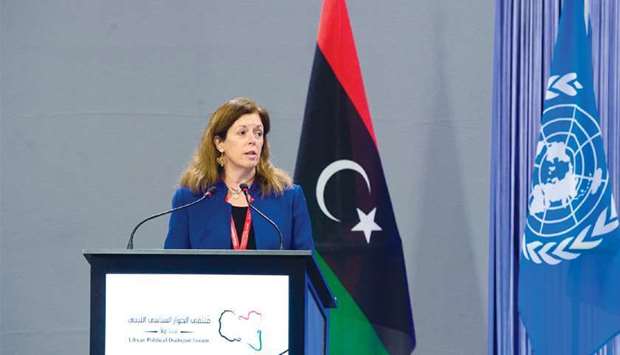
This handout picture made available by the United Nations (UN) shows acting UN envoy for Libya Stephanie Williams delivering remarks at the opening of the Libyan Political Dialogue Forum yesterday, at an undisclosed location near Geneva.