


The European Commission has launched a scheme to monitor, and in some cases bar, exports of vaccines produced in EU plants, amid a row with British-Swedish drugs giant AstraZeneca.
“We paid these companies to increase production, and now we expect them to deliver,” EU Commission vice-president Valdis Dombrovskis told reporters. “Today’s measure has been adopted with the utmost urgency.
“The aim is to provide us immediately with full transparency... and if needed, it also will provide us with a tool to ensure vaccine deliveries.”
EU officials said they expected the order to come into effect today after its publication in the official journal.
The emergency measure is initially for six weeks but is intended to then continue until at least the end of March.
It applies only to those coronavirus vaccines that are covered by advance purchase agreements between drug companies and the European Commission.
Those firms in the EU will have to apply for an authorisation to export doses meant for countries outside the bloc, and show their export records for the previous three months.
A response would normally be given within 48 hours, though that could be extended if necessary.
Most non-EU countries in and around Europe, such as Switzerland, those in the Balkans or micro-states like Monaco, are exempted from the measure.
But Britain, which last year left the EU amid much acrimony, is not.
Brussels has been in a furious dispute with AstraZeneca this week, accusing it of breaching its contract by delaying deliveries to EU governments while maintaining those under a deal it signed earlier with the UK.
But Health Commissioner Stella Kyriakides insisted: “We are not protecting ourselves against any specific country. And we’re not in competition or in a race against any country.”
The prior three-month reporting period would presumably reveal whether or not AstraZeneca did indeed – as has been alleged – send vaccines to Britain from its vaccine plants in Europe, which it says have since been hit by production glitches.
Belgian authorities on Thursday searched one AstraZeneca plant in southern Belgium at the European Commission’s request.
Data seized is being analysed.
EU officials insisted that the scheme is not targeting AstraZeneca alone, but all Covid-19 vaccine-exporting firms tied to the Commission by contracts.
The main goal, they said, was to gather information, though they admitted that in “certain circumstances” vaccine exports could be denied.
“What we want to achieve is of course, a fair approach. And transparency will help us in that respect,” said one official on condition of anonymity.
Vaccines, he said, are “a very strategic product, at a very delicate time”.
The officials noted that the EU’s vaccine procurement portfolio is for 2.5bn doses of authorised and potential vaccines – more than enough for the bloc’s 450mn inhabitants.
That is because the Commission also bought on behalf of poorer countries, with its excess doses to be funnelled through the World Health Organisation (WHO)-led Covax facility.
“We’re not talking about vaccine nationalism,” one official said. “From the beginning we intended to share these vaccines with our neighbours.”
Right now, though, the EU’s vaccination programme is flagging badly, triggering anger among member states.
Yesterday the EU’s medicines regulator recommended the authorisation of AstraZeneca’s coronavirus vaccine for adults of all ages, saying it believed it would be safe for older people too.
The green light by the European Medicines Agency (EMA) had been expected, but there had been questions about whether it would follow the lead of Germany, which declined to recommend it for the elderly.
“With the recommendation today, we are further expanding the range of Covid-19 vaccines available to EU states to bring the pandemic under control,” EMA chief Emer Cooke told a press conference at the agency’s Amsterdam headquarters. “None of them is a magic wand on their own, but together they provide tools and options that we need.”
The vaccine had demonstrated a 60% efficacy against Covid-19 across various clinical trials, the EMA said in a statement.
The regulator added that there were “not yet enough results in older participants” over 55 to show how it would work but that “EMA’s scientific experts considered that the vaccine can be used in older adults”.
The EMA has already approved the Pfizer/BioNTech and Moderna jabs for the 27-nation European Union, plus the European Economic Area countries of Iceland, Liechtenstein and Norway.
Hungary became yesterday the European Union’s first member to approve China’s Sinopharm Covid-19 vaccine, sealing a deal for 5mn doses just a week after becoming the first EU member to buy Russia’s Sputnik V vaccine.
Prime Minister Viktor Orban, whose nationalist government frequently bucks the consensus of its EU neighbours, said he would personally opt to receive the Chinese vaccine, as he trusted it more than others.
The announcement came a day after Hungary’s government issued a decree calling for a green light for any vaccine that had been administered to at least 1mn people in at least three other countries.
China has been heavily marketing its two coronavirus vaccines, made by Sinopharm and Sinovac, with millions of doses shipped around the world to developing countries, particularly in Asia and Latin America.
Meanwhile, EU countries, relying so far almost entirely on a vaccine from Pfizer, have fallen far behind Britain, the US and a number of developing countries in rolling out vaccines.
Hours earlier, Hungary’s drug regulator gave emergency use approval to the Sinopharm vaccine, rather than wait for the bloc’s EMA to give the go-ahead, adding it to a list that also includes the Pfizer, Moderna and AstraZeneca vaccines as well as Russia’s Sputnik-V shot.
Foreign Minister Peter Szijjarto said the Sinopharm vaccines were enough to inoculate 2.5mn people, or about a quarter of its population, delivered in four batches over four months.
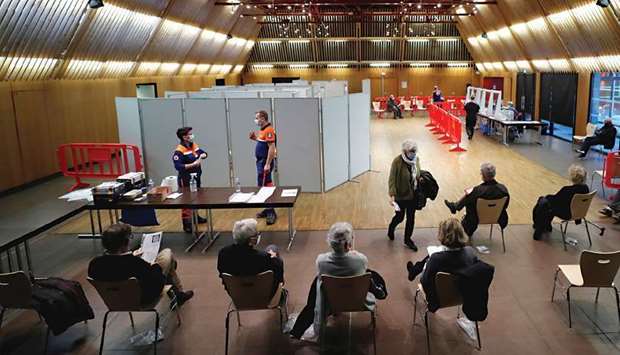
Elderly people aged over 75 years wait yesterday after receiving a dose of the Pfizer-BioNTech Covid-19 vaccine at a vaccination centre in Nantes, France.