


Qatar Red Crescent Society (QRCS) has inaugurated a project to help patients with hydrocephalus in Sanaa, the capital city of Yemen.
The ceremony was attended by Mohamed al-Shumairi, the project’s manager at QRCS’s representation mission; Othman al-Salawi, deputy manager of the Handicap Care and Rehabilitation Fund (implementing partner); staff of the fund, and parents of children with disability.
Around 1,000 children in all governorates of Yemen will benefit from the project, according to QRCS in a statement.
In the inaugural ceremony, al-Salawi welcomed the representatives of QRCS and valued the latter’s humanitarian and life-saving role in alleviating the suffering of children with hydrocephalus in Yemen, amid the absence of international organisations.
Under the project, both external ventricular drains and intraventricular catheters will be provided, as well as the pre, during, and post-procedure medications. It also involves payment for the costs of transportation and accommodation for the poor families that cannot afford the travel to Amanat Al-Asimah.
These activities will cost $309,000, totally paid by QRCS, while the Handicap Care and Rehabilitation Fund will pay for the costs of procedures.
Before the ceremony, the public were informed about hydrocephalus, its symptoms, and treatment by the surgical placement of a cerebrospinal fluid (CSF) shunt system.
Both the personnel of QRCS and the partner made a tour of several governorates, under the theme of “Save a Life”. In his remarks, Hassan al-Hanani, the project’s co-ordinator, talked about the tragedy lived by the patients, saying “many families, especially the poor ones, have children with this condition.”
“Due to the lack of CSF machines at all government health facilities, and the prices are too high for the patients to purchase the machines on the market, the children with hydrocephalus are likely to develop serious conditions such as brain cancer or vision loss. So, an early surgical intervention can minimise the impact and boost their survival chances,” he said.
Al-Shumairi said: “As we completed Phase 1 of the free-of-charge treatment campaign, we were contacted by many families. Over the early days, 23 children underwent surgery. Every family received $200 in cash. So far, the project paid for the transportation and accommodation of 14 poor families from remote areas. For Phase 1, 100 CSF machines have already been procured and delivered by QRCS, out of 1,000 machines”.
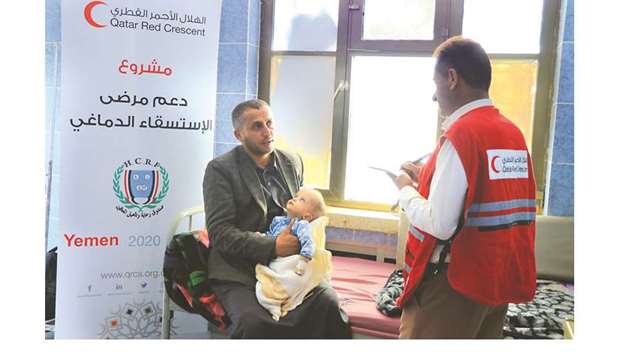
Around 1,000 children in all governorates of Yemen will benefit from the QRCS project.