


British Prime Minister Boris Johnson said yesterday that tougher lockdown restrictions were probably on the way as Covid-19 cases keep rising, but that schools were safe and children should continue to attend where permitted.
The coronavirus causes the Covid-19 respiratory disease.
Covid-19 cases in Britain are at record levels and the increase in numbers is fuelled by a new and more transmissible variant of the virus.
The government has cancelled the planned reopening of schools in and around London but teaching unions want wider closures.
Much of England is already living under the toughest level of restriction under a four-tier system of regional regulations designed to stop the spread of the virus and protect the national healthcare system.
But, asked in a BBC interview about concerns that the system may not be enough to bring the virus under control, Johnson said that restrictions “alas, might be about to get tougher”.
“It may be that we need to do things in the next few weeks that will be tougher in many parts of the country,” he told the BBC’s The Andrew Marr Show. “I’m fully, fully reconciled to that.”
“There are obviously a range of tougher measures that we would have to consider ... I’m not going to speculate now about what they would be,” Johnson added.
The opposition Labour Party leader Keir Starmer said that Johnson must implement a national lockdown within the next 24 hours.
“What we’ve learnt is that the longer you delay the difficult decisions, the worse it is on the health front, the worse it is on the economic front,” he told reporters.
Johnson sets policy for England, with rules in Scotland, Northern Ireland and Wales set by their devolved authorities.
Scottish leader Nicola Sturgeon said her cabinet would meet today to discuss possible further steps to limit the spread of the virus, and ordered Scotland’s parliament to be recalled.
Britain recorded 54,990 new cases of the virus yesterday and has registered more than 75,000 deaths from the pandemic.
Health officials are concerned that the surging numbers could overwhelm hospitals during their busiest time of the year.
The government’s response has been heavily criticised.
But the rollout of vaccines is set to accelerate today with the first 530,000 doses of the newly approved Oxford/AstraZeneca vaccines ready to be administered, Johnson said.
He hoped “tens of millions” would be treated over the next three months.
Millions of pupils are due to return from their Christmas holidays today, and Johnson advised parents to send their children to school in areas where rules allow it.
“There is no doubt in my mind that schools are safe, and that education is a priority,” he said.
Some local authorities and unions have warned against reopening schools and have threatened to act against government advice.
Others say closures also have a big negative impact on students.
“We must renew and maintain the consensus that children’s time out of school should be kept to the absolute minimum,” Amanda Spielman, chief schools inspector, wrote in the Sunday Telegraph.
Jerry Glazier, national executive member of the National Education Union, told AFP yesterday that “schools are now playing a significant part in the spreading of the infection” and called for them all to be closed for at least two weeks.
“Schools are unsafe for the kids and unsafe for the education workers,” he added. “Many teachers are very anxious about going back into the workplace.”
Johnson said that public health experts had highlighted the long term health and social costs of children being kept out of school.
“There are many factors you have to take into account, particularly deprivation in left-behind communities,” he told Marr.
“The issue is, how can you stop schools being places the virus can circulate. Weekly lateral flow testing in schools I believe can make a huge difference.”
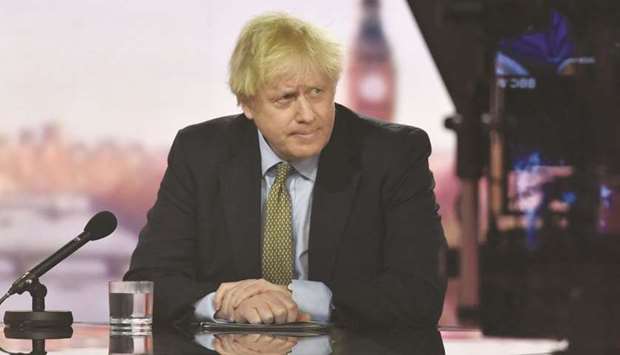
A handout picture released by the British Broadcasting Corporation (BBC) shows Prime Minister Johnson appearing on The Andrew Marr Show weekly political programme at their studio in London.