


The Programme for Social Policy Evaluation and Research (Prosper) at the College of Public Policy (CPP), Hamad Bin Khalifa University (HBKU), has organised a webinar series to discuss the findings of a wide-reaching international research study on Covid-19 family life led by Dr Anis Ben Brik, associate professor at CPP and founding director of Prosper.
‘The Impact of the Pandemic on Family Life Across Cultures’, one of the largest studies of its kind in the world, was conducted in 72 countries from North America, Latin America, Africa, Europe, Asia, Oceania, and the Arab region including Qatar, in partnership with the United Nations Department of Economic and Social Development, 10 universities and research centres, and 17 NGOs.
The global data provided a unique window into the commonalities and differences in how families were shaped by the Covid-19 pandemic on every continent, across all income and education levels, and within all age groups. Topics ranged from parents and child health and anxieties, marital relationship quality, parenting practices, gender roles, fatherhood, family coping and resilience, family satisfaction, domestic violence, intergenerational solidarity, impact of technology and internet addiction, social interactions to family policies.
Bringing together several of the academics and experts who were part of the research team, the webinar series kicked off with Impact of the Pandemic on Family Life in Latin America on December 14, in partnership with the Institute of the Family, University of La Sabana, Colombia; University of Nove de Julho, Brazil; Family-Work Balance Research Centre, Austral University, Argentina; APDES Colegios De Familias, Argentina; Regional Observatory of Latin America and the Caribbean for Women, Mexico; and the Centre for Research and Higher Studies in Social Anthropology (CIESAS), Mexico.
Impact of the Pandemic on Family Life in Asia was held on December 17, in partnership with the Centre for Family and Population Research (CFPR), National University of Singapore, and Focus on the Family Asia.
On December 22, the third webinar, European Results on Large Families of the International COVID-19 Family Life Study, was held in partnership with the European Large Families Confederation, HARO Sweden, International Federation for Home Economics, Germany; and the German Society for Home Economics, Germany.
Upcoming webinars will discuss the results for the Gulf region, North America, Africa, and the Arab region.
Dr Brik said: “The coronavirus pandemic affected every aspect of life, from shuttering schools, closing shops, and halting everyday life in nearly every corner of the globe. Consequently, it is crucial to examine how family life changed during the pandemic and explore how these changes will likely influence future government policy and programming. We have assembled a team of global experts, who together have collected very rich data that is ready to be brought to bear on a slew of pressing global issues facing the family as well as to inform academic and public discourse on families moving forward.”
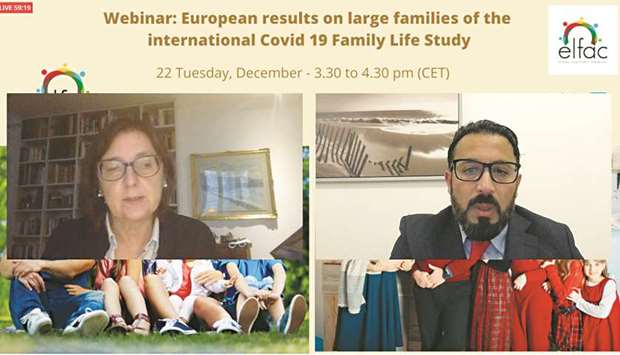
College of Public Policy holds webinar.