


Countries around Europe prepared yesterday to roll out their first coronavirus vaccines even as a reputedly more contagious variant spreads around the world, forcing some nations back into lockdown.
The coronavirus causes the Covid-19 respiratory disease.
The impending inoculation campaigns have boosted hopes that 2021 could bring a respite from the pandemic, which has killed more than 1.7mn people since emerging in China late last year.
First doses of the Pfizer-BioNTech vaccine arrived in EU countries including hard-hit Italy, Spain and France early yesterday, ready for distribution to retirement homes and care staff.
“We’ll get our freedom back, we’ll be able to embrace again,” Italian Foreign Minister Luigi Di Maio said as he urged his countrymen to get the shot.
However, polls show only 57% of Italians intend to get the jab, whereas scientists estimate herd immunity can only be reached if 75-80% have it.
Vaccinations in most of the 27 European Union countries are set to begin today, after regulators approved the Pfizer-BioNTech vaccine on December 21.
The exception is Hungary, which started vaccinating healthcare workers with the Pfizer-BioNTech vaccine yesterday, a day earlier.
Hungary received a first shipment of coronavirus vaccines yesterday morning that will be enough to inoculate 4,875 people, state news agency MTI reported.
The vaccines have been shipped to Budapest with police escort.
“We have started the inoculations among healthcare workers according to a plan defined earlier,” a government spokesman said in a reply to Reuters questions.
Earlier this month, the United Kingdom became the first country in the world to roll out the vaccine made by Pfizer and BioNTech.
However, a new strain that emerged in Britain and spread rapidly has sent jitters through already overstretched health services as countries from Sweden to Japan have reported cases.
Austria began its third national lockdown yesterday and millions also woke to tougher restrictions in Britain, where the vaccine rollout has already begun.
France, Spain and Sweden are among the countries confirming that the new virus strain has reached their shores.
French officials said late on Friday that a Frenchman living in Britain had tested positive after arriving from London, adding that he was not showing symptoms and was isolating.
Four cases were confirmed in Madrid yesterday, though the patients were not seriously ill, the Madrid regional government’s deputy health chief Antonio Zapatero said, adding that “there is no need for alarm”.
The new strain, which experts fear is more contagious, prompted more than 50 countries to impose travel restrictions on the UK.
Thousands of trucks backed up in southern England, but the bottleneck eased after France lifted a 48-hour entry ban for drivers with a negative coronavirus test.
South Africa has detected a virus mutation in some infected people but on Friday denied British claims that its strain was more infectious or dangerous than the one originating in the UK.
Across the world, people are being urged to respect social distancing guidelines.
“Vaccines are offering the world a way out of this tragedy. But it will take time for the whole world to be vaccinated,” said World Health Organisation (WHO) chief Tedros Adhanom Ghebreyesus on Friday.
In the Vatican, Pope Francis pleaded for “vaccines for all” in his traditional Christmas message on Friday, urging leaders from politics and beyond to find a solution “especially the most vulnerable and most in need”.
In authoritarian post-Soviet Turkmenistan, where the government says no coronavirus cases have been detected, President Gurbanguly Berdymukhamedov claimed that licorice root could cure Covid-19.
Without citing any scientific evidence, former dentist Berdymukhamedov claimed that “licorice stops the coronavirus from developing”.
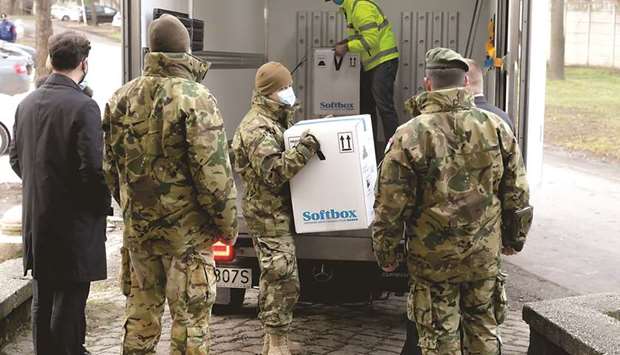
Soldiers carry the first shipment of the Pfizer-BioNTech vaccines yesterday at the Del-Pest Central Hospital in Budapest.