


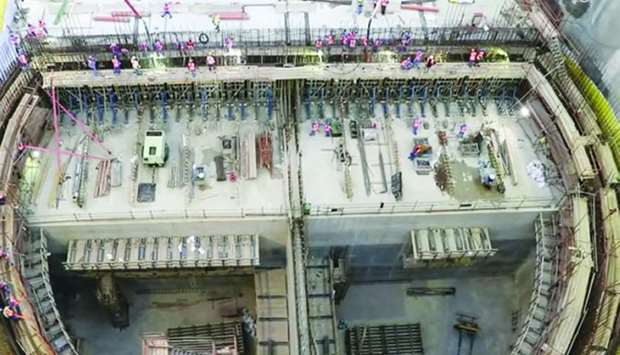
The Mesaimeer Pumping Station and Outfall project will be completed by the end of next year, the Public Works Authority (Ashghal) has said.
The 10km long outfall is being set up at a cost of QR920mn, according to Ashghal's website. The project has achieved remarkable development and Ashghal had completed 50% of works in July this year.

The excavation of the outfall tunnel is at a depth of 15m below the seabed and about 3.7m in diameter and considered a “major construction challenge due to the variable geology that increases the exposure to unexpected conditions”


The station is the longest of its kind in the world and an important step towards providing a sustainable solution for the discharge of surface and stormwater in Qatar. It will accommodate surface and storm water volumes received from the drainage networks located in different areas in Doha.
The water will be treated according to the highest internationally approved specifications, and then pumped 10km away from the seashore via the Mesaimeer Pumping Station and Outfall tunnel. The excavation of the outfall tunnel is at a depth of 15m below the seabed and about 3.7m in diameter and considered a “major construction challenge due to the variable geology that increases the exposure to unexpected conditions”.


The main tunnel at Mesaimeer will connect the existing and future drainage networks. The tunnel will operate to drain surface water from sub-networks located in different areas, spread over an estimated 170sqkm area, and minimise rainwater catchments, especially in tunnels, as it’s connected with rainwater drainage networks in 22 tunnels for vehicular traffic.
The tunnel project will also decrease the surface water level and reduce pumping costs in construction projects across the country. Besides, it will help preserve the foundations of buildings by reducing waterlogging.
The excavation is carried out using a highly specialised tunnel boring machine (TBM) that uses a technique called Earth Pressure Balance and is designed to operate in a range of ground conditions in Qatar, and along the variable geology along the tunnel.
The TBM incorporates advanced technologies that ensure the efficiency of the drilling process, providing the maximum safety standards for tunnel workers and operators, as well as monitoring the work execution through all its stages.
The safety features include a “closed mode” feature, used in the case of ground deterioration to prevent water from entering the tunnel and thus protect the workers, in addition to rescue chambers that protect personnel during emergencies, fire detection and suppression, as well as emergency electricity generation systems.
The excavation of the outfall tunnel is at a depth of 15m below the seabed and about 3.7m in diameter and considered a “major construction challenge due to the variable geology that increases the exposure to unexpected conditions”
A tunnel boring machine breaks through a section
Work in progress
The station is the longest of its kind in the world and an important step towards providing a sustainable solution for the discharge of surface and stormwater in Qatar. It will accommodate surface and storm water volumes received from the drainage networks located in different areas in Doha.
The water will be treated according to the highest internationally approved specifications, and then pumped 10km away from the seashore via the Mesaimeer Pumping Station and Outfall tunnel. The excavation of the outfall tunnel is at a depth of 15m below the seabed and about 3.7m in diameter and considered a “major construction challenge due to the variable geology that increases the exposure to unexpected conditions”.
The main tunnel at Mesaimeer will connect the existing and future drainage networks. The tunnel will operate to drain surface water from sub-networks located in different areas, spread over an estimated 170sqkm area, and minimise rainwater catchments, especially in tunnels, as it’s connected with rainwater drainage networks in 22 tunnels for vehicular traffic.
The tunnel project will also decrease the surface water level and reduce pumping costs in construction projects across the country. Besides, it will help preserve the foundations of buildings by reducing waterlogging.
The excavation is carried out using a highly specialised tunnel boring machine (TBM) that uses a technique called Earth Pressure Balance and is designed to operate in a range of ground conditions in Qatar, and along the variable geology along the tunnel.
The TBM incorporates advanced technologies that ensure the efficiency of the drilling process, providing the maximum safety standards for tunnel workers and operators, as well as monitoring the work execution through all its stages.
The safety features include a “closed mode” feature, used in the case of ground deterioration to prevent water from entering the tunnel and thus protect the workers, in addition to rescue chambers that protect personnel during emergencies, fire detection and suppression, as well as emergency electricity generation systems.