


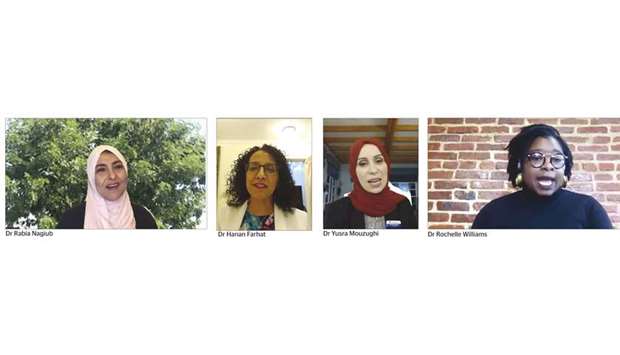
Four senior-level leaders from four academic institutions spoke candidly about their personal experiences and success strategies for women in STEM (science, technology, engineering and math) professions during a recent webinar hosted by the Women’s Faculty Forum at Texas A&M University at Qatar (Tamuq), a Qatar Foundation partner university.
The discussion convened Dr Hanan Farhat, founder and senior research director of the Corrosion Centre at Hamad Bin Khalifa University’s Qatar Environment and Energy Research Institute (Qeeri); Dr Yusra Mouzughi, vice chancellor of Muscat University and the first female head of a university in Oman; Dr Rabia Nagiub, associate professor in the Public Policy Programme at Doha Institute for Graduate Studies; and Dr Rochelle Williams, senior director of programmes at the National Society of Black Engineers (NSBE), US. Tamuq faculty Dr Mary Queen and Dr Tehmina Pirzada served as moderators.
Panellists offered their perspectives on the role of gender in faculty hiring and promotion; strategies to attract a more diverse pool of women faculty applicants; and how male colleagues can support recruitment and retention of women faculty. “One of the major points panellists made was that we aren’t just women, we are women from all sorts of different backgrounds, socioeconomic status and ethnicities,” Queen said. “That, as well as gender, always plays a big part.” Women in academia face greater hurdles than those in industry because of the hierarchical nature of educational institutions, Farhat said. Among the challenges she faced in her first faculty position in the Middle East was lack of respect from students in the predominantly male field of mechanical engineering. She also said she felt overburdened by a heavy workload and found male colleagues less than helpful. “So often, women new to faculty roles are too shy to ask for fair treatment,” Farhat said. She persevered and completed her teaching commitment, then later transitioned from the classroom to a full-time research position.
More flexible working conditions are likely to help employers attract women to STEM careers, panellists noted. Mouzughi said, “Prospective employees want to know how flexible you can make a role. A more welcoming work environment engages women to apply and stay. There should be transparency about where you can take your career. Also, an institution may have family-friendly policies, but if women are frowned upon for using them, that needs to be addressed.”
Williams, who works partially on equitable recruitment, discussed how there’s been more female retention when female faculty are paired for coaching/mentoring with other women faculty (or just faculty in positions of power), and also having a “Writing Happy Hour” once or twice a week to create a specific time and place for research.
Panellists offered ways male colleagues can help their female counterparts, including listening and showing appreciation for their work. They can also help by being available as mentors and sponsors to younger colleagues. Nagiub said, “The nature of the field is very demanding, with long hours spent in teaching, service and research. Women have to show that they are equally competent and qualified in order to gain respect.”
Institutions that want to achieve gender equity should examine the systemic barriers that keep women from being successful once they are hired, Williams said. “We need to continue conversations that shed light on what is needed to promote equity in staffing and leadership.”
..