


Pakistan’s textile and clothing exports grew by 4.88% year-on-year to $6.04bn between July to November FY21 compared to $5.76bn in the same period last year, data released by the Pakistan Bureau of Statistics (PBS) showed yesterday.
In November, export proceeds were up by 9.27% from a year ago. In October, export proceeds were up by 6.18% and in September, they grew by 11.03% while a decline of 15% was recorded in August.
In the first month of the current fiscal year, exports recorded a robust increase of 14.4% on a year-on-year basis. The rebound in exports of textile and clothing is the outcome of a series of incentives to support exporters to meet the challenges in the wake of the pandemic and disruption in supplies.
The demand for country’s exports had collapsed in months following March due to the Covid-19 pandemic, while there has been a gradual improvement since June from international buyers.
Adviser to PM on Commerce in a tweet said that in November, the exports of cotton yarn declined by 25%, raw leather by 21%, and cotton fabric by 12.2%. “This is an indication that exports of low value-added products are decreasing and we are moving towards more value-added exports”, he said while adding that “I urge our exporters to keep pursuing this policy.”
The PBS data showed that ready-made garment exports edged up by 4.36% in value while plunging in quantity by 44.64% during July to November this year from a year ago. Exports of knitwear increased by 14.34% in value and 32.35% in quantity; bedwear exports were up 12.28% while dipped 7.95% in quantity.
Towel exports went up 14.24% in value and 3.79% in quantity, whereas those of cotton cloth dipped 8.73% and 31.78% in quantity.
Among primary commodities, cotton yarn exports plunged by 37.34%, yarn other than cotton by 16.69%, made-up articles – excluding towels – was up 15.53% and tents, canvas and tarpaulin increased by a massive 58.05% during the months under review.
Textile machinery imports dropped by 6.07% during the first five months of current fiscal year – a sign that no expansion or modernisation projects were taken up by the industry in the given period.
Petroleum imports declined 22.78% in the first five months (July-November) to $3.94bn, compared to $5.11bn over the last year, the PBS data showed.
Of these, petroleum product imports were down 16.51% in value in the first five months’ despite increasing by 54.42% in quantity.
Similarly, import of crude oil dipped 27.01% in value, but posted a growth of 14.78% in quantity during the period under review while those of liquefied natural gas fell by 34.73% in value.
On the other hand, liquefied petroleum gas (LPG) imports jumped 52.06% in value in July-November largely to plug a shortfall in local production.
Machinery imports went down 5.78% to $3.37bn in the first five months from $3.58bn last year. The decline in imports was recorded in almost all kinds of machinery except power generating machinery, office machinery and mobile phones.
The power generating machinery imports went up 21.73% in the first five months mainly due to revival of power projects under the China-Pakistan Economic Corridor and office machinery increased by 0.7% during the months under review.
In the telecommunication sector, imports surged by 31.32% on the back of mobile handsets arrivals which were up by 45.26%. This was the result of a crackdown on smuggling and doing away with free imports in baggage schemes. Import of other apparatus fell by 6.39%.
The overall transport group witnessed a growth of 13.92%. This growth was mainly driven by an increase in imports of road motor vehicles (build unit, CKD/SKD) and CBU during the months under review.
An increase of 60.36% was seen in imports of textile group – raw cotton, synthetic and artificial silk yarn.
Overall food group import jumped by 44.53% to $3.01bn during the first five months this year as against $2.08bn from a year ago. The government is importing wheat and sugar to bridge local shortages. The import of almost all essential food products such as milk, wheat, dry fruits, tea, spices, palm oil, soybean oil, pulses and sugar witnessed growth during the months under review.
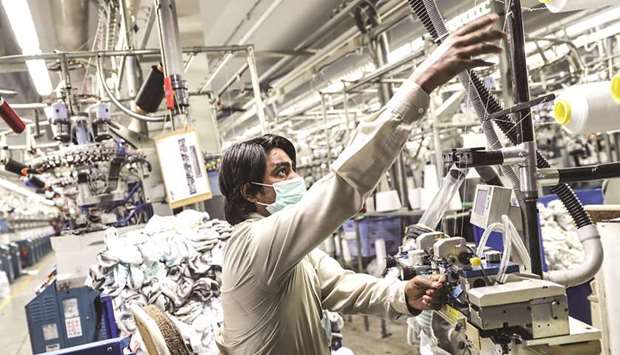
An employee works at the knitting section of a garment factory in Faisalabad, Pakistan (file). The demand for the country’s exports had collapsed in months following March due to the Covid-19 pandemic, while there has been a gradual improvement since June from international buyers.