


Poorer countries will begin to receive coronavirus vaccination doses early next year from a facility created to ensure fair access, the World Health Organisation (WHO) and its partners said yesterday.
The coronavirus causes the Covid-19 respiratory disease.
Almost 2bn doses of candidate vaccines have been secured for the Covax facility, run by the WHO along with the Gavi vaccine alliance and the Coalition for Epidemic Preparedness Innovations (CEPI).
Countries including the United States and Britain have already begun to roll out a vaccine developed by Pfizer and BioNtech, with another developed by Moderna expected to gain widespread approval soon.
Neither drug is included in the 2bn doses, but the WHO said it was in discussions with both companies.
“The arrangements announced today will enable all participating economies to have access to doses in the first half of 2021, with first deliveries anticipated to begin in the first quarter of 2021,” the WHO, Gavi and CEPI said in a statement.
Shipments of enough vaccines to protect health and social care workers would be delivered “in the first half of 2021 to all participating economies who have requested doses in this timeframe”, the statement said.
It said deliveries were contingent upon regulatory approvals and countries’ readiness for delivery.
WHO chief Tedros Adhanom Ghebreyesus told a virtual press conference that “light at the end of the tunnel has grown a little bit brighter”.
“But we will only truly end the pandemic if we end it everywhere at the same time, which means it’s essential to vaccinate some people in all countries, rather than all people in some countries,” he said.
The statement said that by the end of the year, 20% of the populations in participating countries should be covered.
The WHO revealed yesterday that it had signed an agreement with US pharmaceutical giant Johnson & Johnson for 500mn doses of a candidate drug, adding to agreements already signed with AstraZeneca, Novavax and Sanofi-GSK.
The UN health agency has previously said it was willing to include vaccines developed in China and Russia should those drugs prove safe and effective.
CEPI chief Richard Hatchett said massive research and development efforts were paying off.
“We now have safe and effective vaccines that can protect against Covid-19 and a clear pathway to securing 2bn doses for the populations at greatest risk all around the world,” he said.
Gavi chief Seth Berkley meanwhile hailed the “unprecedented speed and scale” of the project.
“Securing access to doses of a new vaccine for both higher-income and lower-income countries, at roughly the same time and during a pandemic, is a feat the world has never achieved before,” he said.
Covax is a collaboration between organisations, companies and 190 countries – but neither the United States nor Russia have joined so far.
Canada will donate Covid-19 vaccines to other countries if it receives more doses than necessary, Prime Minister Justin Trudeau has said in a television interview.
Reuters reported in November that Canada was in talks to donate shots to lower-income countries, but Canadian officials have not previously made any public commitment.
“As Canada gets vaccinated, if we have more vaccines than necessary, absolutely we will be sharing with the world,” Trudeau said in a CTV interview, which is set to air tomorrow.
Trudeau did not outline how donations might work.
Canada has reserved more vaccine doses per capita than any other country.
In the unlikely event that all the experimental vaccines perform well in trials, it could access enough doses to vaccinate the Canadian population more than five times over.
It is not yet clear what might be considered an extra dose, or whether Canada would consider exercising options under its purchase contracts in order to donate doses.
Meanwhile, the European Commission refused to comment directly yesterday on a leak of how much it would pay for Covid-19 vaccine doses, stressing confidentiality clauses with the companies involved.
Spokesmen for the EU executive were questioned about the information revealed on Thursday in a tweet by a junior minister in Belgium’s government that gave a cost breakdown of six vaccines in the Commission’s portfolio.
The tweet was deleted shortly afterwards, but screen grabs of it were quickly posted on social media.
“We cannot say anything about this,” one of the spokesmen, Stefan de Keersmaecker, told journalists, without denying the tweet’s accuracy.
“Everything that has to do with information of prices of vaccines is covered by confidentiality. This is something which is very important,” he said.
The Commission’s chief spokesman Eric Mamer added that secrecy over the prices paid was “contractually required” by the companies supplying the vaccines.
Without that, he said, “we would not have had those contracts”.
The tweeted information showed the prices for six of
the seven vaccines that the
Commission has bought.
Price per dose ranged from €1.78 ($2.20) for a potential vaccine by British-Swedish company AstraZeneca, to €14.70 ($18) for the most expensive jab, from the US firm Moderna.
The price for the Pfizer/BioNTech vaccine – so far the only one to receive authorisation, for use in the UK, the US and probably next week the EU – was given as €12 a dose.
Contacted by AFP for comment, Pfizer did not immediately respond.
De Keermaecker said that the confidentiality clause in the contracts was not only to protect “sensitive business information” but also “the public’s interest”.
“If all this sensitive information were to be made public, this would weaken the position of the negotiators of the Commission and the member states involved in these negotiations,” he said.
The tweeted information gave the following price per dose for each vaccine maker, in either euros or US dollars according to the respective contract:
AstraZeneca: €1.78
Johnson & Johnson: $8.50
Sanofi/GlaxoSmithKline: €7.56
Pfizer/BioNTech: €12
Curevac: €10
Moderna: $18
Separately, on Thursday, the European Commission announced a seventh contract with US biotech company Novavax for 100mn doses, the price of which was not given under the confidentiality agreement.
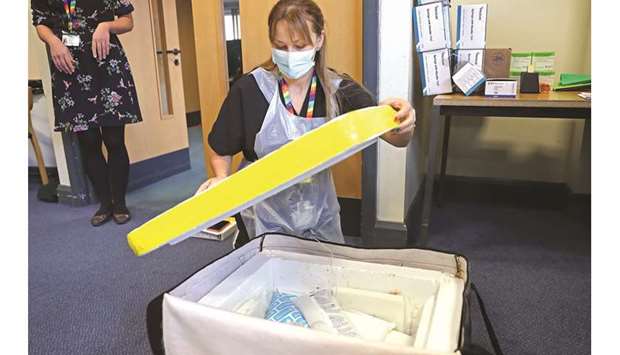
On delivery, the live Pfizer-BioNTech Covid-19 vaccine is transferred to a fridge for storage at the Gloucestershire Vaccination Centre at Gloucestershire Royal Hospital, central England.