


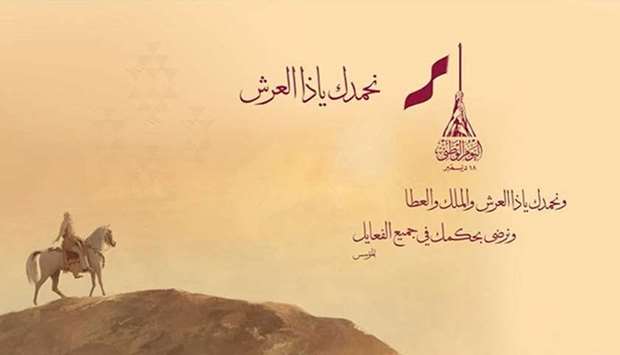
The State of Qatar celebrates National Day today to commemorate the founding of the state in 1878 by Sheikh Jassim bin Mohamed bin Thani, while continuing in the path of growth and development towards building a knowledge-based society, with sustainable development and positive participation, asserting its national identity and adhering to the foundations of its heritage, values and culture.
The State of Qatar has made giant steps in this regard, as the wise leadership laid foundations inspired by the visions of its founder.
This was accomplished through an enlightened process based on community cohesion and rallying around the leadership, which has been strongly demonstrated in dealing with challenges, adapting and overcoming them with a firm belief in values, and the resolve and wisdom of the leadership and the loyalty of Qataris.
Qatar presented an honourable model for the cohesion of all components of society when the Gulf Crisis in June 2017 imposed a new reality on society.
His Highness the Amir Sheikh Tamim bin Hamad al-Thani provided an example to be emulated when it comes to enlightened leadership.
Since the first day of his reign, His Highness the Amir charted the way with strength and confidence, declaring: “We are people who are committed to our principles and values.
“We do not live on the sidelines of life, and we do not go adrift without a destination … we are not subservient waiting guidance from anyone.
“This independent pattern of behaviour has become factual in Qatar and to those who deal with us.
“We are people with vision.”
On November 3, His Highness the Amir announced in his speech at the opening of the 49th session of the Shura Council that elections will be held in October next year.
This is an extension of the Shura process and an enhancement of popular participation in decision-making in support of the development process.
In June, His Highness the Amir announced the completion of the Education City Stadium, the third stadium for the FIFA World Cup 2022, in which he greeted “the champions of these times: the medical staff and all the staff of the teams working on the frontline against the Covid-19 (coronavirus) pandemic,” adding, “as the world begins to open up, it is through your courage, dedication and sincerity that we truly believe in better days to come.”
With the conclusion of the second decade of the 21st century, we review some major milestones in the country’s journey.
In 2008, a future roadmap was drawn up under the title “Qatar National Vision 2030”, which aims to transform Qatar into an advanced country capable of achieving sustainable development, and ensuring the continuation of decent living for its people by 2030.
On December 2, 2010, Qatar won the right to host the FIFA World Cup 2022 for the first time in the Arab world and the Middle East region.
This accomplishment was a catalyst for integrating mega projects into the context of goals included in the four pillars of the Qatar National Vision 2030.
Coinciding with the 10-year anniversary of Qatar winning the 2022 World Cup, the Supreme Committee for Delivery & Legacy announced on December 3 that 90% of the infrastructure work for this tournament had been completed, two years before its launch, including five of the eight stadiums designated for the tournament.
In a related topic, Qatar’s National Team achieved a historic victory in February last year, winning the AFC Asian Cup 2019 in the final match that took place in Abu Dhabi, dominating the team and individual awards.
The process of reform and development covered all aspects of life and society in the State of Qatar, and included a large number of major projects that have been completed and those that are underway.
Qatar’s economy has shown efficiency and flexibility, as it came in the first place in the Arab world in the Global Competitiveness Report published by the World Economic Forum (WEF).
Qatar was ranked 29th, which means that it surpassed 112 countries in the ranking.
Qatar ranked first in the Middle East region in terms of communication infrastructure, according to the WEF’s Networked Readiness Index (NRI), which is a reliable indicator to determine the level of development in the country.
Qatar ranked 23rd in the world and has maintained the same position since 2013.
According to the Global Food Security Index, Qatar has maintained 1st position in the Arab world for the second year in a row, and has advanced globally from 22nd place in 2018 to 13th place in 2019.
Qatar is among the top 20 countries out of a 190 countries that have implemented reforms related to the ease of doing business for the year 2020, according to the World Bank business team.
According to the 2018 Global Entrepreneurship Monitor, Qatar ranked 1st in the entrepreneurial environment out of 54 countries around the world.
It also ranked 1st in the Arab world in the safety index according to the Global Finance Magazine’s 2019 global safety and security metrics.
..