


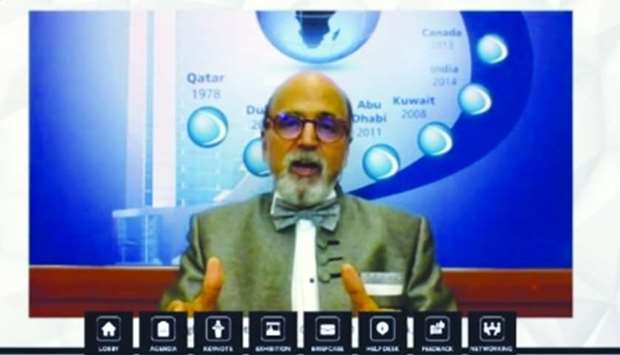
Total bilateral trade between the GCC and India currently stands at $121bn, Doha Bank CEO Dr R Seetharaman said during the ‘Almus Rupee Money Conference 2020’ hosted recently by National Stock Exchange of India and Almus Risk Consulting.
According to Seetharaman, Qatar’s major exports to India include petrochemicals, LNG, fertilisers, sulphur, and iron pyrites, while Qatar’s major imports from India include accessories, man-made yarn, fabrics, made-ups, cotton yarn, transport equipment, machinery and instruments, manufacture of metals, ores and minerals.
He said many Indian companies, such as L&T, Tata Projects, Voltas, and Punj Lloyd have “active relationships” in the Qatari market through partnerships, agencies, and have even set up offices in Qatar. The Indian population in Qatar is nearly 750K. Doha Bank has a three full-fledged banking branches in India, he said.
“QNB also received approval for retail operations. In January 2019, Qatar Investment Authority invested $200mn through a primary equity issuance in Bharti Airtel’s arm, Airtel Africa. In July 2019, BYJU’S (Indian learning App) announced that it received an investment of $150mn led by QIA, which is investing about $450mn for a 25.1% stake in a unit of Adani Transmission.
“The deal includes a subordinated debt investment by QIA, which is eyeing to stake up a $1.5bn stake in India’s Reliance Jio Fibre in 2020. As per World Bank report in April 2020, it expects the remittances to India from GCC to fall by 23% to $64bn in 2020 from $83bn in 2019,” Seetharaman said.
He said Qatar and India had set up a task force to identify investments projects in India following the agreement between HE the Minister of State for Energy Affairs Saad bin Sherida al-Kaabi and Oil Minister Dharmendra Pradhan.
Seetharaman said the Tatweer programme offers infra, office space, introduces business, and helps in creating entire value chain to support small and medium-sized enterprises (SMEs) in Qatar.
“Qatar Development Bank (QDB) can help in providing equity whereas debt can be funded by other banks. India’s bilateral trade is set to grow with Qatar; this is given Qatar’s world-class seaport, airport, free zones, a new public-private partnership model, and an approved Foreign Investment Law to promote non-Qatari investments.
“Qatar is an AA- rated country and Doha Bank is rated A3 with stable outlook, the country offers low cost of financing and also has a sovereign fund, plus gold reserves with the central bank, which is two times of GDP reflecting inherent strength of the economy,” Seetharaman said.
On the Indian economy, Seetharaman said the IMF expects India’s GDP growth to bounce back to “8.8%” in 2021, “one of the highest” amongst emerging markets and developing economies.
He said the country has been stable with its credit ratings, which is placed currently at investment grade at BBB-. India reported current account surplus of $19.8bn, which is 3.9% of GDP in June 2020.
The RBI holds Forex reserves of “$568.5bn, which is at new life-time highs as on November 6, 2020.”
“Indian banks also reported better results showcasing reduction in slippages, better recoveries, strong growth in CASA mobilisation lowering cost of funds, and lower provisions.
“The FDI investments as per RBI reported is projected to be at $42.6bn by the end of fiscal year 2020-2021. RBI has been supportive with frequent announcements of its purchases via open market operations; this has led to 10 year bond yields at 5.93%,” Seetharaman explained.
On regional economies, Seetharaman said Qatar’s economy is expected to contract by “4.5% in 2020” and recover by “2.5% in 2021.” Qatar and other regional economies had witnessed economic reforms to recover from Covid-19 as oil fell this year, he said.
“Qatar Central Bank came with various procedures to combat the risk of the coronavirus pandemic. This includes the emergency procedures, loans and liabilities of sectors affected due to procedures taken to combat the spread of Covid-19, guarantees for local banks and the National Guarantee Programme to support the private sector.
“In May 2020, the Public-Private Partnership Law was introduced. The private sector is expected to leverage from this new law. In October 2020, Qatar allowed foreigners to own property. Qatar stock market has surged by close to 0.5 % YTD (as on closing of December 15) and has crossed 10k levels,” Seetharaman said.
He said many Indian companies, such as L&T, Tata Projects, Voltas, and Punj Lloyd have “active relationships” in the Qatari market through partnerships, agencies, and have even set up offices in Qatar. The Indian population in Qatar is nearly 750K. Doha Bank has a three full-fledged banking branches in India, he said.
“QNB also received approval for retail operations. In January 2019, Qatar Investment Authority invested $200mn through a primary equity issuance in Bharti Airtel’s arm, Airtel Africa. In July 2019, BYJU’S (Indian learning App) announced that it received an investment of $150mn led by QIA, which is investing about $450mn for a 25.1% stake in a unit of Adani Transmission.
“The deal includes a subordinated debt investment by QIA, which is eyeing to stake up a $1.5bn stake in India’s Reliance Jio Fibre in 2020. As per World Bank report in April 2020, it expects the remittances to India from GCC to fall by 23% to $64bn in 2020 from $83bn in 2019,” Seetharaman said.
He said Qatar and India had set up a task force to identify investments projects in India following the agreement between HE the Minister of State for Energy Affairs Saad bin Sherida al-Kaabi and Oil Minister Dharmendra Pradhan.
Seetharaman said the Tatweer programme offers infra, office space, introduces business, and helps in creating entire value chain to support small and medium-sized enterprises (SMEs) in Qatar.
“Qatar Development Bank (QDB) can help in providing equity whereas debt can be funded by other banks. India’s bilateral trade is set to grow with Qatar; this is given Qatar’s world-class seaport, airport, free zones, a new public-private partnership model, and an approved Foreign Investment Law to promote non-Qatari investments.
“Qatar is an AA- rated country and Doha Bank is rated A3 with stable outlook, the country offers low cost of financing and also has a sovereign fund, plus gold reserves with the central bank, which is two times of GDP reflecting inherent strength of the economy,” Seetharaman said.
On the Indian economy, Seetharaman said the IMF expects India’s GDP growth to bounce back to “8.8%” in 2021, “one of the highest” amongst emerging markets and developing economies.
He said the country has been stable with its credit ratings, which is placed currently at investment grade at BBB-. India reported current account surplus of $19.8bn, which is 3.9% of GDP in June 2020.
The RBI holds Forex reserves of “$568.5bn, which is at new life-time highs as on November 6, 2020.”
“Indian banks also reported better results showcasing reduction in slippages, better recoveries, strong growth in CASA mobilisation lowering cost of funds, and lower provisions.
“The FDI investments as per RBI reported is projected to be at $42.6bn by the end of fiscal year 2020-2021. RBI has been supportive with frequent announcements of its purchases via open market operations; this has led to 10 year bond yields at 5.93%,” Seetharaman explained.
On regional economies, Seetharaman said Qatar’s economy is expected to contract by “4.5% in 2020” and recover by “2.5% in 2021.” Qatar and other regional economies had witnessed economic reforms to recover from Covid-19 as oil fell this year, he said.
“Qatar Central Bank came with various procedures to combat the risk of the coronavirus pandemic. This includes the emergency procedures, loans and liabilities of sectors affected due to procedures taken to combat the spread of Covid-19, guarantees for local banks and the National Guarantee Programme to support the private sector.
“In May 2020, the Public-Private Partnership Law was introduced. The private sector is expected to leverage from this new law. In October 2020, Qatar allowed foreigners to own property. Qatar stock market has surged by close to 0.5 % YTD (as on closing of December 15) and has crossed 10k levels,” Seetharaman said.