


The National Human Rights Committee (NHRC) organised a seminar under the title ‘Developing human rights mechanisms during the coronavirus (Covid-19) pandemic and beyond in various sectors’ with the participation of the ministries of public health and interior.
The seminar comes within the framework of the NHRC’s celebrations of the International Human Rights Day, which is marked this year under the slogan “Better re-building.”
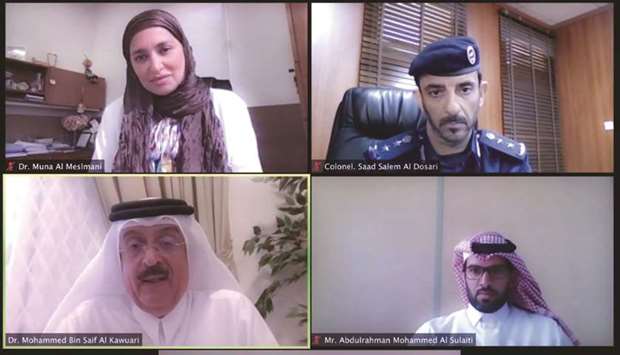
NHRC Deputy Chairman Dr Mohamed bin Saif al-Kuwari, in his speech, said that the pandemic has affected the interests of various State institutions in all their sectors, especially those related to direct interaction with the public.
This, he said, made it imperative for those public institutions to activate alternative ways to continue achieving their goals and messages and to adhere to their responsibilities towards all members of society, and to find the best ways to develop the mechanisms of national human rights institutions in light of the pandemic and its aftermath in terms of speeding the response and administrative efficiency in order to upgrading the level of services to the public.
He noted that the work of national institutions is not limited to only receiving complaints.
It also includes providing recommendations and advice regarding national, regional and international legislation, conducting visits and monitors the human rights situation in public and private sector institutions in everything related to human rights in health, education, work and other basic rights, in addition to raising awareness among all sectors of society in the context of their role in protecting human rights and preserving its dignity, mobilising the energies of society on understanding and practicing its rights and duties, and applying the values of social justice and tolerance and promoting equality and non-discrimination.
He pointed out that all the abovementioned axes need to be rebuilt in a better way in line with the global trend and commensurate with the burdens on national human rights institutions.
Al-Kuwari said that the NHRC has already applied the process of benefiting from electronic systems since the breakout of the Covid-19 pandemic and relying on social distancing as a means to limit the spread of the epidemic among members of society.
These methods have proven their effectiveness and ability to complete all transactions and have saved a lot of time and effort in light of reducing the human workforce and applying home quarantine to 80% of the workforce, he added.
He said that the development of human rights mechanisms has become an absolute necessity in the post-Covid pandemic, especially in light of the biggest challenge of national human rights institutions since 2015, which is the United Nations recognition of national human rights institutions as a main mechanism in the process of implementing and following up the implementation of sustainable development goals.
For her part, Medical Director of the Communicable Diseases Center at HMC Dr Muna al-Maslamani presented a working paper on the necessity to adhere to precautionary measures in case of health emergencies in order to promote the right to health.
She said that in this pandemic, there are two ethical factors that enter the line of human health rights and that no health strategy should neglect them, namely the right to educate society about the risk of contracting the virus and the right to access real information about the developments of the pandemic.
Dr al-Maslamani added that they used many means to achieve this right through audio-visual communication, newspapers, in addition to social media.
She stressed the importance of regularly disseminating information related to the virus, and how to prevent the spread of the pandemic, as well as statistics related to the infection and recovery.
At the same time, she highlighted the need for accuracy and updating of this information, as well as awareness of the importance of accessing services, and need for all information to be available and accessible, which is what has been taken care of since the pandemic’s beginning by educating the public through text messages in multiple languages.
She addressed the local experience in Qatar to confront the virus and the challenges for the health sector in this aspect, and how it was dealt with.
Dr al-Maslamani also reviewed the efforts made by the Ministry of Public Health, noting that since the coronavirus was announced as a global pandemic on March 11, 2020, the ministry has dealt with it as one of the biggest challenges facing humanity in the modern era.
For his part, Assistant Director of Human Rights Department at the Ministry of Interior Colonel Saad Salem al-Dosari made a presentation under the title ‘The role of law enforcement officials in following up preventive measures and respecting human rights’. He reviewed the tasks of law enforcement responsibilities and preserving the right to public health, in addition to the efforts of the Ministry of Interior in preventing the pandemic.
This pandemic is a real test and challenge for states, governments, organisations and civil society institutions, he said.
He pointed out that this pandemic has caused great damage to human rights, foremost among which is the right to life, work, movement and peaceful assembly, because of measures required to impose control and preventive restrictions in the framework of quarantine, social distancing and other measures.
Abdulrahman Mohamed al-Sulaiti from the Legal Affairs Department of the NHRC also made a presentation.
..