


The coronavirus causes the Covid-19 respiratory disease.
The new curbs will apply until January 10, with companies also urged to allow employees to work from home or offer extended company holidays, under the new measures agreed by Chancellor Angela Merkel with regional leaders of Germany’s 16 states yesterday.
“That would help to implement the principle ‘we’re staying at home’,” according to the policy paper agreed by Merkel and state premiers.
Germans are urged to limit their social contacts to another household, with a maximum of five people excluding children under 14 meeting at each time.
From Christmas Eve to Boxing Day, the contacts would be eased to allow gatherings with another four people excluding children, but who should be limited to close relatives or partners.
Germany in November closed leisure and cultural facilities and banned indoor dining in restaurants.
The measures had helped to halt rapid growth of infections after the autumn school holidays, but numbers had plateaued at a high rate.
Merkel had repeatedly pushed for tougher curbs to break the chain of contagion, but implementation of the rules is in the hands of individual states and some were reluctant to impose more curbs.
The mood however has changed in the last week after Germany recorded new daily death tolls reaching close to 600 and as the country’s disease control agency RKI reported that the infections trend had taken a worrying turn.
“Today is not the day to look back or to see what could have been, rather, today is the day to do what is necessary,” said Merkel, pointing to “very high numbers of deaths” and stressing the urgent need for action.
Germany recorded another 20,200 new Covid-19 cases over the past 24 hours, reaching a total of 1,320,716 cases, according to RKI data published yesterday.
Another 321 patients died from the disease from a day earlier, bringing the total death toll to 21,787.
“With increasing mobility and the resulting associated contacts in the pre-Christmas period, Germany is now in exponential growth of infections numbers,” said the policy paper agreed by regional leaders and Merkel.
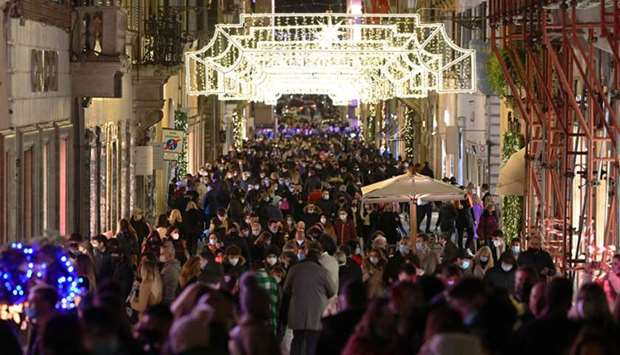
While hospitals in some regions are warning that their intensive care units are reaching capacity, huge queues of shoppers were building downtown ahead of the festive period.
The Federation of Retailers HDE warned that the new restrictions could threaten almost one in two jobs in the industry.
But Finance Minister Olaf Scholz said the government will offer help of up to €11bn a month to help companies weather the storm.
Merkel’s government has repeatedly said that new infections must be brought down to 50
per 100,000 people, but the
rate is currently at 169.1 per 100,000.
Spain should achieve herd immunity from Covid-19 by the end of summer 2021 if enough people are vaccinated by then, the health minister said in an interview published yesterday.
Salvador Illa said a vaccination programme will start in January, and by the end of the summer more than two-thirds of the population of 47mn should be vaccinated.
“In Europe, even if it is not the final end, we will be in a very different stage. That is why I think we are at the beginning of the end with this time horizon that I say, from five to six months,” he told Publico newspaper.
Asked if this meant that Spain would achieve herd immunity, Illa replied: “Yes. It is what the technicians call that, that people have immunity either because they are vaccinated or because they have had the disease.”
Spain has been one of the worst hit countries in Europe by the coronavirus.
New cases rose by 10,519 to 1,730,575 on Friday, according to health ministry data, while the number of deaths increased by 280, bringing the total to 47,624.
In Russia, Moscow will not impose a curfew or curb sales of beverages during the New Year holiday, despite a rise in coronavirus cases, the mayor of the Russian capital was quoted as saying by Interfax news agency yesterday.
Russia, which began vaccinating exposed groups in Moscow, a city of nearly 13mn, earlier in December, has resisted imposing a strict lockdown as it did early this year, relying on targeted measures instead.
“We do not restrict meetings, nor do we declare curfews,” Interfax reported, citing the mayor Sergei Sobyanin. “Tightening (anti-virus restrictions) is only possible when the medical system can no longer cope with the flow of patients.
“There is no such situation in Moscow. The safety margin is still quite large,” he added.
Russian officials reported 488 Covid-19 deaths in the last 24 hours, taking the country’s official death toll to 46,941.
Authorities also confirmed 28,080 new cases of the novel coronavirus in the previous 24 hours, including 6,425 in Moscow, pushing the national tally to 2,653,928 since the pandemic began.
The directors of five of Switzerland’s largest hospitals have written to the health minister, asking for urgent measures to reduce coronavirus infections, the SonntagsZeitung newspaper reported yesterday.
In their letter to Health Minister Alain Berset, the directors of the university hospitals of Zurich, Bern, Basel, Lausanne, and Geneva said the pandemic was forcing them to postpone operations for patients with other life-threatening conditions, while intensive care beds were becoming scarce.
More than 4,000 operations have been postponed at the five hospitals since October, the newspaper reported.
Switzerland has been hard hit by the epidemic, with around 5,000 new Covid-19 cases every day recently.
Roughly 1.3% of the population has been infected in the last 28 days.
The directors said they feared a third wave of Covid-19 infections early next year could trigger a collapse in the health system.
A spokesman for the Swiss Department of Public Health declined to comment on the letter.
Lithuania has asked citizens to stay at home for three weeks from Wednesday as it seeks to rein in a raging coronavirus spread that has seen the country jump from 18th to third worst-hit in the European Union in just six weeks.
Leaving home will be permitted only for work, essential shopping, caring for the sick, funerals and for people to take walks in single household groups, Prime Minister Ingrida Simonyte announced.
All non-essential shops will be closed and meetings between households banned.
As of yesterday, Lithuania reported 1,178 coronavirus cases per 100,000 people over the past two weeks, three times more than the 340 cases per 100,000 when a lighter lockdown was announced on November 4.
By that measure, the country now lags only Croatia and Luxemburg on the European Centre for Disease Prevention and Control’s list of worst affected countries.
“There is no safe place in Lithuania,” Simonyte told reporters after announcing the curbs at the first meeting of her government since being sworn in on Friday.