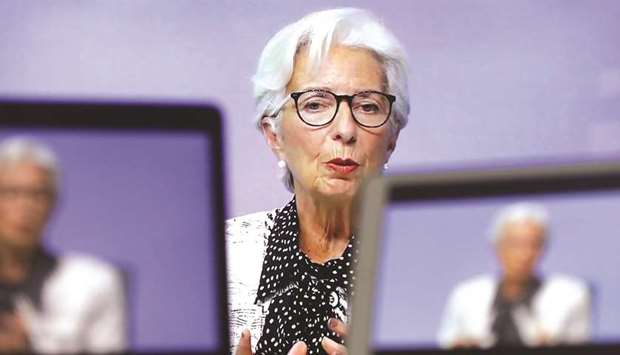
European Central Bank chief Christine Lagarde unleashed more stimulus yesterday to help the eurozone confront a second coronavirus wave, and warned that the outlook remained fraught with uncertainty over the pandemic’s evolution and the rollout of vaccines.
At its final meeting of the year, the 25-member governing council boosted and extended their emergency measures to prop up the euro economy after a flare-up in Covid-19 cases halted a summer recovery and forced another round of restrictions.
The services sector especially is suffering under the renewed shutdowns, Lagarde said, while consumers “remain cautious” as they fret over jobs and money despite unprecedented efforts from governments and the ECB to support companies and households.
Lagarde said it would likely take until early 2022 for the recovery to take root, assuming that scientists are right in saying vaccines will have given the world “sufficient herd immunity” by the end of next year.
The ECB’s most drastic move was to bulk up its main virus-fighting tool, its pandemic emergency bond-buying programme (PEPP), by €500bn ($600bn) to €1.85tn.
It also prolonged the scheme from June 2021 to March 2022.
The corporate and government bond purchases are aimed at keeping borrowing costs low to encourage spending and investment, in the hopes of boosting growth and driving up inflation.
The ECB also said it would offer more ultra-cheap loans to banks next year and extend the scheme’s most generous terms to June 2022.
Under so-called Targeted Long-Term Refinancing Operations (TLTRO), banks get more generous rates the more they lend on to the real economy, particularly small businesses.
As observers had predicted, ECB governors left interest rates unchanged at historic lows.
They also made no tweaks to their pre-pandemic asset purchases, keeping the current pace of 20bn a month.
“The monetary policy measures taken today will contribute to preserving favourable financing conditions over the pandemic period,” Lagarde told reporters in Frankfurt.
“At the same time, uncertainty remains high, including with regard to the dynamics of the pandemic and the timing of vaccine roll-outs.”
Lagarde had in October all but promised that extra monetary support was under way, and the newest moves fell within market expectations.
The ECB “did not present a big new bazooka but a well-engineered extension of all well-known instruments to ensure that the current level of monetary accommodation is extended until at least the spring of 2022, hoping for the vaccine to have done its job by then,” said ING bank analyst Carsten Brzeski.
Lagarde also unveiled the ECB’s latest growth forecasts, which showed that the 2020 recession will likely be less severe than feared.
The 19-nation economy is now projected to shrink by 7.3% this year, compared with -8.0% forecast in September.
Next year’s rebound, however, is expected to come in at a smaller-than-expected 3.9%, before seeing a bigger jump in 2022. Hopes that Europeans are on the cusp of a mass vaccination campaign against Covid-19 helped to brighten the outlook.
But Lagarde warned that the inoculations would take time and “further resurgences in infections with challenges to public health and economic prospects cannot be ruled out” in the meantime.
The forecasts also showed that eurozone inflation is expected to inch up from 0.2% this year to 1.4% by 2023, keeping the ECB’s target of just under 2.0% far out of reach.