


Agencies/London
Britain yesterday marked 30 years since an Argentinian invasion of the Falklands triggered a bloody 74-day war, amid renewed tensions between London and Buenos Aires.

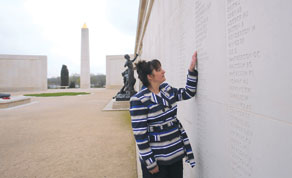
Margaret Allen, wife of British serviceman Iain Boldy, who was killed in an Argentine attack on his ship HMS Argonaut during the Falklands conflict on May 21, 1982, looks at his name engraved on a memorial at the National Memorial Arboretum in Staffordshire, central England, yesterday
British veterans of the conflict gathered for a low-key service of remembrance, after Prime Minister David Cameron described the invasion of the South Atlantic islands as a “profound wrong”. The then ruling junta in Argentina stunned the world when it landed troops in the capital of the Falklands, Port Stanley, on April 2, 1982.
The war ended in defeat for Argentina, costing the lives of 649 Argentine troops and 255 British servicemen, after Margaret Thatcher sent in a naval task force to reclaim the territory.
Once the British troops had made the 13,000km voyage, they were locked in an often bloody battle, hilltop by hilltop, until Britain wrested back control of the windswept islands it has ruled since 1833.
Argentina renewed its claims of sovereignty over what it calls the Malvinas two years ago when Britain authorised oil companies to explore the waters around the archipelago. It has also accused Britain of militarising the seas around the islands, taking its complaints to the UN.
The island’s oil reserves, which remain untapped until now but which analysts predict could be worth tens of billions of dollars, have been a major bone of contention between the two countries since their discovery in 1998.
Cameron said Britain remains “staunchly committed to upholding the right of the Falkland Islanders, and of the Falkland Islanders alone, to determine their own future”.
“Thirty years ago the people of the Falkland Islands suffered an act of aggression that sought to rob them of their freedom and their way of life,” he said. Britons were “rightly proud of the role Britain played in righting a profound wrong”, he added, paying tribute to the “prosperous and secure” society built there since the war.
At the National Memorial Arboretum in central England, a candle was lit in memory of the veterans who lost their lives and will burn for 74 days to represent the duration of the conflict. Commander Peter Mosse, who captained a British naval frigate during the war, said after the service that the conflict was the product of the domestic situation in Argentina, which in 1982 was under the rule of a military junta.
“It was a very sad and unnecessary conflict because we were about to come to an arrangement with the Argentinians about the future of the Falklands by talking, by working things out, as things should be done,” he said.
In a deliberately low-key service at the arboretum which lasted no more than 10 minutes, the congregation of fewer than 100 prayed for reconciliation between Britain and Argentina. A memorial to the 255 British servicemen who lost their lives is nearing completion in the arboretum grounds. It will be dedicated on May 20, in the presence of around 600 veterans.
Frigate heads to South Atlantic amid tension
Britain will send a high-tech warship to the South Atlantic this week, the ministry of defence announced yesterday. The HMS Dauntless, a powerful Type 45 destroyer, will leave its base in Portsmouth, southern England, tomorrow for a six-month deployment in the South Atlantic, a ministry spokesman said. “It’s going to the South Atlantic, not specifically to the Falklands,” the spokesman stressed. The Dauntless is armed with Sea Viper missiles, which the Royal Navy says can protect a naval task force from aerial threats up to 113kms away. The ministry would not say when the Dauntless, which joined the British navy in 2010, would arrive in the South Atlantic, as it said it did not give details on the position of its ships. Meanwhile Defence Secretary Philip Hammond has rejected claims that Britain would be unable to defend the Falklands against a fresh Argentinian assault. Speaking as Britain’s new Joint Forces Command comes into effect, Hammond said Britain would “robustly” defend the islands against any attack and insisted “we have the assets, the people, the equipment in place to do so”.