


France’s next-generation aircraft carrier will be nuclear-powered and replace the national fleet’s flagship warship, the Charles de Gaulle, in 2038, President Emmanuel Macron said yesterday.
The 11th carrier-vessel in the French Navy’s history will be built by French defence contractor Naval Group and equipped with the new electromagnetic aircraft launch system developed by US company General Atomics, French officials said.
The carrier will be 300m (984’) long and have a deadweight of 75,000 tonnes.
It will be able to carry up to 30 Rafale fighter jets, or the successor of the Dassault warplane currently being developed by France, Germany and Spain.
The French military had initially lent towards a ship with conventional propulsion, but together with Macron later opted for a nuclear-powered vessel, despite heavier construction costs.
“Out strategic future, our status as a great power, lies with the nuclear industry,” Macron said during a visit to a nuclear sector components maker.
France is continental Europe’s only nuclear power.
Britain is a nuclear power too, though its relationship with the European Union – from trade to security – once it leaves the EU’s orbit on January 1, is uncertain.
The French state will invest €1bn during the first development phase that will end in 2025, the ministry of armed forces said.
Ministry officials declined to comment on media reports that the vessel could cost more than €5bn ($6.05bn).
“Naval Group is very proud to build the largest warship ever built in France,” the company chief executive, Pierre Eric Pommelet, said in a statement.
Three other Western aircraft carriers have been built since the Charles de Gaulle was first deployed: the US Navy’s Gerald R Ford and America, and the British Royal Navy’s Queen Elizabeth, which cost about £3.1bn ($4.03bn).
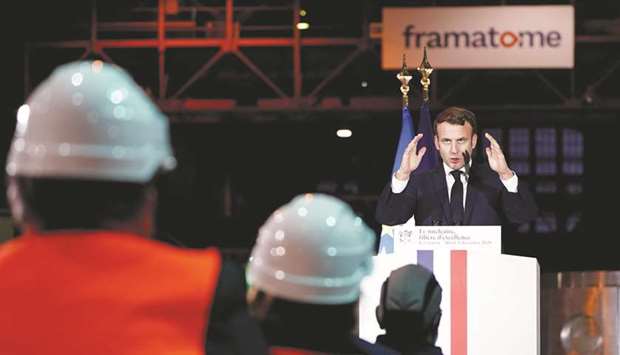
President Macron delivering his speech during a visit to the Framatome nuclear reactor production site in Le Creusot, France.