


What the Pittsburgh Steelers hope to accomplish today doesn’t carry the historical significance of, say, Joe DiMaggio’s 56-game hitting streak.
It won’t go into the sports pantheon of memorable milestones alongside UCLA’s 88 consecutive wins, Cal Ripken’s 2,632 consecutive games played or the Boston Celtics’ run of eight NBA championships in a row.
In NFL annals, it hardly measures up to Brett Favre’s run of 297 starts in a row, and it likely won’t generate any banner headlines or make the ESPN crawl if it comes to fruition.
Still, the Steelers can tie the NFL record for most consecutive games with at least one sack today, and while that alone doesn’t carry much sizzle or swagger, it is illustrative of how consistent the defence has been at pursuing quarterbacks over the past four-plus years.
The Tampa Bay Buccaneers set the little-known streak in 69 consecutive games from 1999-2003. The Steelers have done it 68 games in a row, a streak that began November 6, 2016, at Baltimore.
In that span, the Steelers have 233 sacks (including two team sacks), more than any other team.
After leading the NFL in sacks the past three seasons, the Steelers again occupy the top spot with 41 sacks during their 11-0 start. And with Washington allowing 35 sacks, tied for the third-highest total in the NFL, it’s a safe bet the Steelers will drop 36-year-old quarterback Alex Smith at least once today.
Although the record is within reach, it’s not exactly a topic of conversation in the Steelers locker room.
“We’ve never really talked in depth about any of that stuff,” said All-Pro outside linebacker TJ Watt, who was in his final season at Wisconsin when the sack streak began. “We’re just trying to be the best team we could possibly be. All that matters is getting the win.”
Although other long-time Steelers defensive players such as Cameron Heyward, Stephon Tuitt and Bud Dupree had a head start on Watt, he leads the pack with 45.5 sacks during the streak. Dupree, who is out for the rest of the season with a torn ACL, has contributed 35.5 and Heyward 32 over those 68 games.
“Quality players, it starts there,” coach Mike Tomlin said. “Guys like Bud, T.J., Cam and Tuitt, they provide a wave that we ride. They are good individually. They are good collectively, and they are consistent in terms of their performances. I’ve been a part of several groups like that.”
Tomlin was on the Tampa Bay staff for the final three years of its 69-game run, working on a defensive unit led by long-time coordinator Monte Kiffin.
Tomlin said it was difficult to compare eras and systems, but he did find a common thread between the two.
“We had really good individual rushers in Tampa, guys like Warren Sapp and Simeon Rice, but it was more than that,” he said. “They rushed collectively well together, much like the group we have here. We have guys that you can characterize as really good individual rusher, but they rush well together. The understanding of the larger body and how they fit in to it makes it happen for them.”
When Keith Butler took over as defensive coordinator in 2015, he tried to keep some of the same concepts deployed by predecessor Dick LeBeau, architect of the zone blitz. The Steelers had 48 sacks in Butler’s first season, but things took a while to click in 2016.
After seven games that season, the Steelers had eight sacks. Total.
In four of those seven games, they didn’t generate a single sack.
Beginning with that 21-14 loss in Baltimore, the Steelers reeled off 30 over the final nine games. No team has been better at pressuring the quarterback since.
“We’re not the Blitzburgh that we used to be, but we certainly are not far from it,” Butler said. “We don’t use as many blitzes as we used to, basically a four-man rush for the most part. We do sprinkle in some blitzes with five-man, and the start of the year, we used some six-man stuff around the goal line. We will do whatever we have to do to make sure we maintain the pressure on the quarterback.”
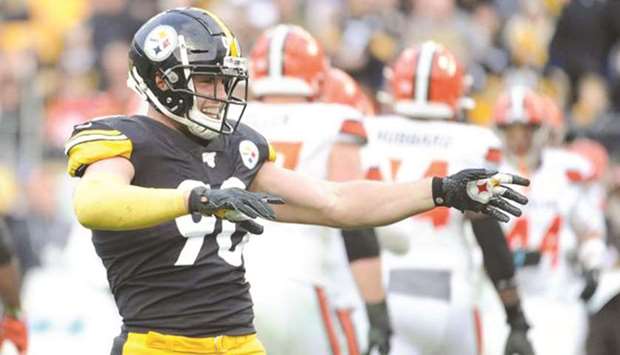
In this December 1, 2019, picture, Pittsburgh Steelers linebacker TJ Watt celebrates a tackle against the Cleveland Browns at Heinz Field in Pittsburgh, Pennsylvania, United States. (USA TODAY Sports)