


Qatar Charity (QC) has taken part in the World Innovation Summit for Health (WISH) through a panel discussion, ‘The pathway to localisation: The importance of building health capacity in developing countries’, and the ‘Innovators of Tomorrow’ initiative, in addition to a pavilion at the virtual exhibition held on the sidelines of the conference.
WISH is a global health initiative of Qatar Foundation.
Four senior experts from leading organisations participated in the discussion, whose main objective was to strengthen action towards localisation and to inform on the urgent need to recognise and support local communities in being the decision-makers and the leaders of solutions impacting their healthcare systems, QC said in a statement.
The discussion also aimed to keep abreast of current good practices and innovative approaches in the field, while identifying common challenges and opportunities to link national healthcare strategies with broader global localisation frameworks.
During the panel discussion, Ishrat Ullah, head of Relief at Qatar Charity, said QC has provided health assistance worth $24mn to nearly 60 countries around the world to help them fight Covid-19. He also underlined the importance of social awareness and community education, indicating that the “conscious community will ask the local government to strengthen the health system and provide efficient health services”.
He said that QC’s teams working in developing countries face some challenges in the health field, adding that Qatar Charity focuses on building the capacities of the local community and strengthening the local health system, so that the local community members can respond first in case of emergencies and disasters.
The Qatari assistance was lauded, as Dr Robert F Walters, chairman of Orbis, said the huge assistance his organisation receives from Qatar Fund for Development (QFFD) and Qatar Charity makes it easier for it to carry out its tasks.
Bashayer AlAli, International Programmes director at QFFD, spoke about building resilience, identifying the gap and meeting local needs, noting that QFFD focuses on the local community, achieving sustainable development and finding local solutions for local needs.
Mohamed Amad, chairperson of Humanitarian Network Pakistan, spoke about the national plan to strengthen the health system and engage the local community and private sector in this regard. He also noted that they work in the most vulnerable areas in order to support the health system and educate the local community about the importance of hygiene, health and nutrition.
Qatar Charity’s pavilion at the virtual exhibition held on the sidelines of the conference displays its experiences and projects in the field of health, and provides information about its areas of work. The pavilion also sheds light on QC’s partnerships with United Nations and other international organisations, and its efforts aimed at preventing the coronavirus.
The ‘Innovators of Tomorrow’ initiative was launched in co-ordination with the Ministry of Education and Higher Education. Workshops were organised for the students of four schools as part of the initiative to inform them of what countries, institutions and civil society organisations did in the field of health. A special pavilion has also been set up for students at the virtual exhibition of the WISH conference to display their production and creativity.
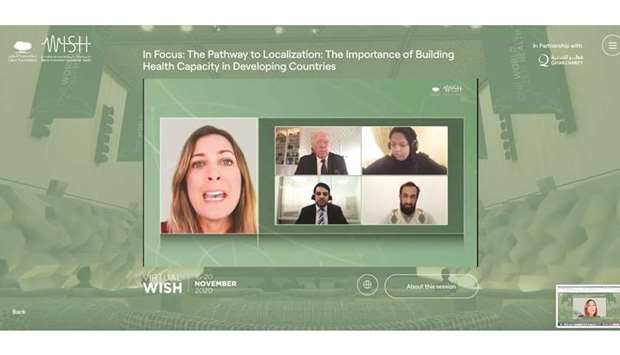
The panel discussion in progress.