


Bloomberg/London
UK jobless claims rose more than economists forecast in January and unemployment held at the highest rate for 16 years in the fourth quarter as the economy contracted.

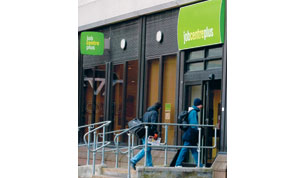
People enter a job centre in Bromley yesterday
The number of people claiming jobless benefits rose by 6,900 to 1.6mn, the highest since January 2010, the Office for National Statistics said yesterday in London.
The median of 24 forecasts in a Bloomberg News Survey was for a gain of 3,000.
Unemployment measured by International Labour Organisation methods rose by 48,000 to 2.67mn in the fourth quarter, leaving the rate at 8.4%, the most since the end of 1995.
The data fuelled opposition claims that Prime Minister David Cameron is trying to cut the budget deficit too quickly after the economy shrank 0.2% in the fourth quarter.
Government forecasters predict unemployment will reach 8.7% by the end of 2012 as the private sector fails to make up for the loss of tens of thousands of public-sector jobs.
“The UK labour-market data continue to paint a bit of a mixed picture, but the key point is that unemployment is still rising,” said Vicky Redwood, an economist at Capital Economics in London.
“We continue to expect unemployment to rise much further in response to the weakness in the wider economy.”
Bank of England policy makers voted last week to pump another £50bn into the economy by May.
Governor Mervyn King said yesterday the latest rise in unemployment reflected the weakness of an economy battered by the euro-area debt crisis.
“The height of unemployment is a concern for everyone,” King told a press conference in London after the central bank published its quarterly Inflation Report.
“These are not figures anyone would choose to have. We have a very difficult adjustment to make in our economy and there’s no point in pretending otherwise. This is a consequence of it.”
The increase in the number of people claiming jobless benefits last month left the claimant-count rate at 5%.
Claims rose 1,900 in December instead of the 1,200 initially reported. Employment rose by 60,000 during the fourth quarter to 29.1mn, prompting the government to argue that the labour market is showing signs of stabilising.
The Unison labour union said the jobless figures showed the government’s economic policies aren’t working, with a third of those unemployed in the fourth quarter having been out of work for longer than a year.
A record number of people are working part-time because they cannot find full-time jobs. The move to expand asset purchases came despite tentative signs of recovery, with indexes of manufacturing, services and construction all rising in January.
The Confederation of British Industry, the country’s biggest business lobby, said earlier this week that the economy will avoid a slump and growth will pick up this year.
Cameron is counting on hiring at private companies to offset about 700,000 public-sector jobs losses by 2017 as a result of his budget squeeze.
Royal Bank of Scotland Group, Britain’s biggest government-owned lender, said on February 10 that it will cut as many as 300 mainly London-based staff in its capital markets and cash equities units after failing to find a buyer for the businesses.
Britain to avoid recession: central bank
The Bank of England yesterday said Britain will likely avoid another recession but cautioned that the outlook was dependent on the successful resolution of the stubborn eurozone debt crisis. Gross Domestic Product is expected to grow by about 1% this year and more than 2% in 2013, while inflation will fall under its 2% target later this year, the bank said in a quarterly report. “We can take some reassurance from the fact that inflation is now falling,” said BoE governor Mervyn King, presenting the report at a press conference in central London. “But we are steering a course through choppy waters and many people are experiencing difficult times.” The BoE expected annual Consumer Prices Index (CPI) inflation to hit its 2% target in the final quarter of 2012 and to fall as low as 1.5% in the following year. The GDP predictions were in line with the BoE’s previous forecasts but the inflation guidance was markedly lower.