


The Special Adviser to the Secretary-General of the United Nations’ office, in co-operation with Qatar’s Ministry of Foreign Affairs, organised a celebration of the 75th United Nations Day, as part of the anniversary of the founding of the international organisation, which falls on October 24 each year.
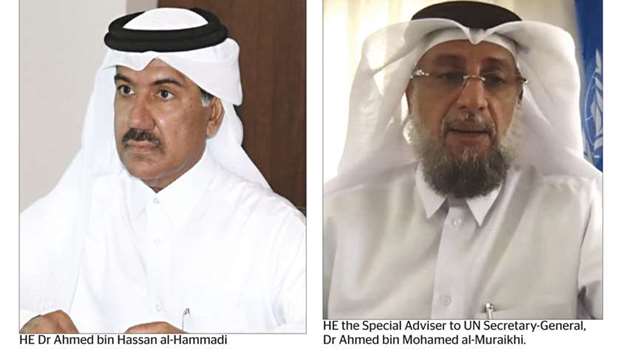
HE the Secretary-General of the Ministry of Foreign Affairs Dr Ahmed bin Hassan al-Hammadi, Special Adviser to the Secretary-General of the United Nations Dr Ahmed bin Mohamed al-Muraikhi, UN agencies represented by the International Labour Organisation, the International Organisation for Migration (IOM), Office of the United Nations High Commissioner for Human Rights (OHCHR) along with United Nations High Commissioner for Refugees (UNHCR), World Food Programme (WFP), UNRWA, United Nations Population Fund (UNFPA), Unesco, and a number of senior officials in the government, diplomatic corps, and representatives of charitable and youth institutions and civil society organisations and universities, research institutions and the private sector in Qatar participated in the ceremony, which took place yesterday via visual communication technology.
In his speech during the ceremony, HE Dr al-Hammadi reaffirmed that Qatar is responsible for and supportive of the position of the United Nations, its various entities and the noble efforts to achieve the goals of sustainable development.
In this regard, he pointed out that Qatar’s support for the United Nations stems from its firm belief that the organisation has the ability to overcome international crises through its work to achieve international peace and security, combat terrorism, achieve sustainable development goals and face common challenges, foremost among which are climate challenge and climate change.
HE Dr al-Hammad also stressed Qatar’s position regarding the full respect for the sovereignty of states as a means to create societies that enjoy stability, development and social justice, in addition to its belief that reliable partnerships in accordance with international frameworks can contribute to achieving security and stability in the Arab region and beyond.
He added that Qatar remains politically committed to the ideals of pluralism and to the United Nations, and continues to provide financial contributions. He gave an example with the funding provided to support the efforts of the United Nations in Lebanon in the wake of the explosion that occurred earlier this year and to the World Health Organisation as part of the response to the Covid-19 pandemic.
HE Dr al-Hammad added that Qatar is also committed to developing sustainable programmes and initiatives in alliance with the United Nations, adding that on September 9 of this year, the Education Above All Foundation and its global partners Unicef and Unesco celebrated the first International Day to Protect Education from Attack, where world leaders and activists addressed the need to take immediate measures on the ground to protect education, declaring that silence about premeditated murder for children in the classroom puts policymakers on the wrong side of history.
He noted that Qatar joined the United Nations in 1971 in order to represent the state and facilitate its relations with the international organisation, adding that the same year also witnessed the formation of the permanent delegation of Qatar to the United Nations in New York.
This was followed by the opening of Qatari missions at the United Nations in Geneva, Vienna, Rome, Nairobi and others.
HE Dr al-Hammad said the past year witnessed more development of relations between Qatar and the United Nations, and despite the global pandemic that has greatly affected works in 2020, Qatar continues to support multilateral efforts and UN organisations, and this is demonstrated clearly through the opening of many UN offices in Doha and the establishment of the United Nations House.
HE Dr al-Hammad indicated that this International Day was established by a decision of the United Nations General Assembly following an action call by Her Highness Sheikha Moza bint Nasser, Chairman of the Board of Directors of the Education Above All Foundation (EAA) and a member of the United Nations Sustainable Development Goals, which is a global platform for decision-makers to focus on protecting education in conflict and building peace, referring to the suffering of more than 75mn children aged between 3 and 18 who live in 35 countries affected by crises and in need of urgent educational support.
He said that Qatar has an active participation in United Nations meetings and its collective efforts, as it plays the role of mediator in international crises, works to promote interreligious dialogue, supports the alliance of civilisations, protects human rights at home and abroad, and participates in decision-making by financing development, relief and reconstruction.
For his part, HE Dr al-Muraikhi stressed that Qatar’s support for the multilateral system is clearly evident, especially as we are facing a pandemic, and despite this, the state plays a pivotal role in contributing to confronting it, with promoting a vision for the future that is fully consistent with the values of the UN.
He added: “In Qatar, we celebrate the anniversary of the UN, and through partnerships with member states, international and national NGOs, the private sector and United Nations personnel that we can truly rebuild better and recover from the diverse impacts of the pandemic.”
He said the United Nations Day is a day for discussion, and an opportunity to evaluate the work of the UN as well as its goals and principles.
HE Dr al-Muraikhi noted that there is no other world organisation with the legitimacy and the ability to unite ranks, highlighting that the current circumstances created an urgent need for all countries to join forces to fulfil the United Nations Charter.
He praised the UN personnel and all those who often spend their lives in the service of promoting peace, development and defending human rights around the world.
..