


Germany agreed yesterday to offer more aid to its airports to try to save jobs and preserve infrastructure as the Covid-19 pandemic continues to wreak havoc on the aviation industry.
Berlin will discuss with the states financial options for airports over the next two weeks, according to a joint statement from the government and representatives of the aviation industry seen by Reuters ahead of an aviation summit in Berlin.
“Additional joint efforts by the federal and state governments are required to secure the economic basis of the airports in the medium term,” the document said.
Plummeting passenger numbers mean 25-30% of the roughly 180,000 jobs at Germany’s airports are at risk, Transport Minister Andreas Scheuer earlier told Deutschlandfunk radio.
Berlin’s long-overdue new airport opened on last Saturday just as the aviation industry struggles with collapsing demand.
It is not expected to make enough revenue to pay back its debts.
The German industry has demanded compensation of up to €1bn ($1.2bn) to help cover the costs of keeping airports open even when there is barely any traffic due to lockdowns.
There was no mention of this sum in the document.
The government is examining possibilities to bridge or cover the loss of revenue at state air traffic control association DFS to prevent a sharp increase in fees for airlines, the document said.
It also wants to expand long-haul routes, which are profitable for airlines but have been largely suspended, by exempting passengers on selected flight corridors from Covid-19 entry restrictions.
To do this, it plans to establish pre-defined testing and quarantine regimes with health authorities.
The transport ministry also wants to prevent ‘dumping prices’ for airline tickets in the future, so that they can’t cost less than taxes and fees.
Support for Europe’s aviation sector has varied among states, with Germany and France the biggest contributors via bailouts for Lufthansa and Air France-KLM, according to a study in the Journal of Air Transport Management.
Britain has so far resisted demands for specific financial support to the industry, although UK airports and airlines such as IAG’s British Airways have benefited from government wage subsidies, emergency loans and financing facilities available across the economy.
Meanwhile, the German government believes flag carrier airline Lufthansa could need more money next year, Der Spiegel magazine reported, citing an internal government document, though the government dismissed the report as “speculation”. It also cited an unnamed government representative as saying that officials and politicians were “losing patience” with airline chief Carsten Spohr, adding that there were doubts that he was the right man to make the savings needed.
But Hermann Thiele, a major shareholder, told the magazine he had confidence in Spohr: “Carsten Spohr is the right man in this difficult situation.”
“The government put together a comprehensive rescue package for Lufthansa, creating liquidity for the company,” the Economics Ministry said in a statement. “We will not get involved in speculation about the company’s condition.”
Germany’s largest airline, which received a €9bn ($11bn) state bailout out in June, on Thursday reported a quarterly loss of €2bn after the coronavirus pandemic decimated the global travel industry.
Spohr has previously said that the bailout should last Lufthansa until the end of 2021.
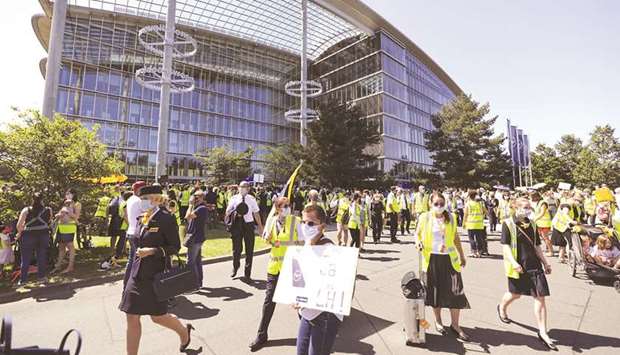
Deutsche Lufthansa employees wearing protective face masks hold banners and umbrellas as they protest outside the Lufthansa Aviation Center at Frankfurt Airport. Berlin will discuss with the states financial options for airports over the next two weeks, according to a joint statement from the government and representatives of the aviation industry.