


Stock markets rallied yesterday as investors saw the potential for US tax hikes fade while the dollar slid ahead of a key Federal Reserve update.
London’s FTSE 100 rose 0.4% to 5,906.18 points, Frankfurt’s DAX 30 closed 2.0% up at 12,568.09 points.
Paris’ CAC 40 ended 1.2% up at 4,983.99 points, while the Euro STOXX 50 finished 1.7% higher at 3,213.76 points.
The knife-edge US presidential race has tilted toward Joe Biden, with Democrat wins in Michigan and Wisconsin bringing him close to a majority.
But President Donald Trump claimed that he was being cheated – an unprecedented complaint unsupported by any evidence – and has gone to court to try and stop vote counting.
Even if the outcome of the White House race is still uncertain, investors see greater certainty of continued divided government with Republicans holding control of the US Senate, which would frustrate any effort by a Biden administration to raise taxes.
“Likely Republican control of the Senate should put paid to increased corporate regulation and taxation while a new administration in the White House may well dial down tensions with other global superpowers on issues like trade,” noted AJ Bell investment director Russ Mould.
“This certainly seemed to be the thinking in Asia overnight as Japanese and Chinese equities staged substantial rallies.”
Europe picked up the baton by extending strong gains won on Wednesday and Wall Street also built upon the previous days gains.
“Political uncertainty and a rally in equities do not normally go together but some people are taking the view that Mr Biden might not be able to do a whole lot should he trump the Donald in the race to the White House, as the Senate will probably remain under Republican control,” said market analyst David Madden at CMC Markets UK.
Hopes for a new economic rescue package out of Washington also provided support to equities, even though any spending bill will not be as big as previously thought under a Democrat-run Congress.
Dealers were also keeping tabs on coronavirus developments with England going into lockdown for a second time, joining France and other key European economies, though observers said they had largely been priced into markets now.
The Bank of England yesterday unveiled an extra £150bn ($195bn) in cash stimulus as it forecast a deeper recession than previously thought for the coronavirus-wracked UK economy.
The BoE said recovery would depend also on Britain striking a post-Brexit trade deal with the European Union.
The EU yesterday warned that Europe’s economy would not return to pre-virus normality before 2023.
The pound rose 0.9% against the dollar yesterday, also amid uncertainty over the election outcome and a Federal Reserve rate decision, said Michael Hewson, chief market analyst at CMC Markets UK.
“Given the current electoral uncertainty it is quite likely that the Federal Reserve will reiterate its determination to support the US economy over the course of the next few months,” he noted.
“Today’s announcements are vital steps to shelter the UK economy through a difficult winter. The extension of the furlough scheme will help provide a much needed bridge for households and businesses until the economy can reopen,” said Ambrose Crofton, global market strategist at JP Morgan Asset Management.
“However, the risk remains that for many businesses, faced with the uncertainty of how long this crisis may last, they may decide to make lasting decisions to either cut jobs or cease trading.”
Auto distributor Inchcape Plc jumped 6.6%, after a beat-and-raise quarter, while Trainline Plc jumped 12.5%, as JP Morgan upgraded the stock to ‘overweight’ after first-half results.
Supermarket group Sainsbury’s Plc tumbled 5.2% after it reported a first-half pretax loss and warned of 3,500 job cuts in restructuring.
The Fed was unlikely to offer much in the way of specifics later yesterday at the end of its two-day policy meeting, besides repeating its commitment to keep the benchmark borrowing rate at zero for the foreseeable future.
But Fed Chair Jerome Powell could take the opportunity to signal a willingness to find new tools to help the economy, after the bank earlier this year pumped trillions of dollars of liquidity into the financial system and cut the US lending rate.
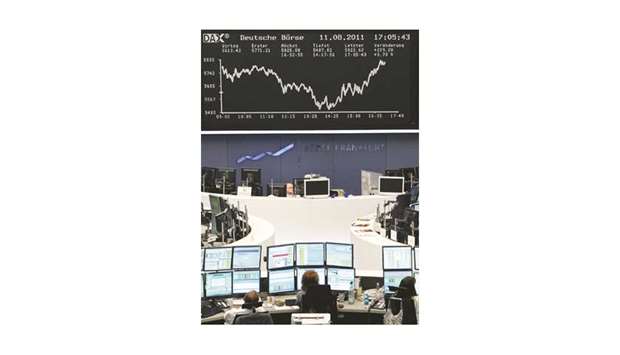
Traders work on their computers below a display of the DAX index curve at the Frankfurt Stock Exchange. The DAX 30 closed 2.0% up at 12,568.09 points yesterday.