


Indonesia suffered its first recession in over two decades as the Covid-19 pandemic hit consumption and business activity in Southeast Asia’s largest economy, costing millions of jobs, the statistics bureau said yesterday.
Gross domestic product (GDP) shrank by a slightly more than expected 3.49% year-on-year as household consumption and investment fell in the third quarter, official data showed.
Economists in a Reuters poll had expected GDP to decline 3% after a 5.32% contraction in the second quarter.
Finance Minister Sri Mulyani Indrawati told a news conference the “the worst is over” pointing to a sharp rebound in quarterly GDP in the July-September period.
But a separate statistics bureau survey showed some 2.6mn people had lost jobs in the year to August due to Covid-19, pushing the unemployment rate to a nine-year high of 7.07%.
A 9.8% rise in government spending helped soften the blow, but economists called on more stimulus to lift the economy.
“The government will focus on further accelerating economic recovery and returning to positive economic growth,” said Sri Mulyani, adding authorities would boost spending in the fourth quarter.
The rupiah and the main stock index briefly pared gains after the data.
Indonesia’s first recession since the Asian financial crisis in 1998 – normally defined as two consecutive quarters of economic contraction – comes as the country has struggled to contain the coronavirus outbreak.
It has the highest caseload and Covid-19 death toll in Southeast Asia.
Indonesia introduced restrictions to contain the spread of the virus earlier this year, many of which were lifted in June, but the government imposed a second round of curbs in Jakarta for a month in September.
Household consumption, normally the economy’s main growth engine, fell 4% on an annual basis in the third quarter, while investment dropped 6.5% and exports tumbled 10.8%.
GDP grew a non-seasonally adjusted 5.05% quarter-on-quarter, up sharply from a 4.19% contraction in the second quarter but below a 5.34% forecast in the Reuters poll.
The government had spent 52.8% of its 695.2 tn rupiah ($48.3bn) pandemic-relief budget year-to-date, official data showed.
“Given the unfathomably slow pace of fiscal stimulus disbursement...the pressure is on monetary policy to do more,” said Wellian Wiranto, economist with OCBC.
Bank Indonesia (BI) governor Perry Warjiyo has said the central bank has further room to act after 100 basis points of rate cuts this year and more than $30bn of government bond purchases.
BI’s next monetary policy review is scheduled on November 18-19.
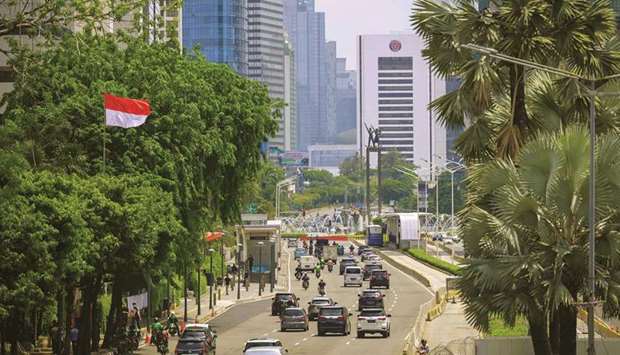
This picture taken on October 30 shows light traffic along a main road in central Jakarta after months of the government’s policy implementing work from home. Indonesia’s GDP shrank by a slightly more than expected 3.49% year-on-year as household consumption and investment fell in the third quarter, official data showed.