


Punjab Chief Minister Amarinder Singh yesterday led a protest at Delhi’s Jantar Mantar to get “justice for poor farmers”.
He said he was not in Delhi to confront the central government but to fight for farmers’ rights, whose livelihood was at stake due to new farm laws.
“We are not here to disturb peace but to preserve it”, Singh said, adding that he and other legislators from Punjab were forced to come to Delhi as President Ramnath Kovind had declined their request for a meeting.
Though they had earlier planned a relay protest at Rajghat in New Delhi, they had to shift to Jantar Mantar as Delhi police clamped section 144 at the Mahatma Gandhi memorial, Singh said.
Singh hoped that the central government will look at Punjab and its problems considering the sacrifices made by Punjabis through the decades.
He rubbished claims of Punjab’s farmers resorting to anti-national activities, reiterating that their agitation against the farm laws was peaceful.
Punjabis are at the borders fighting for the country and have sacrificed their blood safeguarding the nation’s safety and security, Singh said.
He reiterated his warning that any move by the central government to tinker with religion or livelihood of the people would trigger resentment and anger.
The farmers are protesting since the new laws by the central government will harm them and snatch away food from their children, he said, adding “we are all ready to give our blood for the nation, as we Punjabis have always done”.
The chief minister warned that failure to resolve the issues of farmers would cause unrest.
He urged the central government to look at the plight of the small and marginal farmers, which comprise 75% of Punjab’s farming community.
Highlighting the crisis faced by Punjab due to the Indian Railways’ decision of not sending goods trains to the state, the chief minister said contrary to the misinformation being spread, tracks were currently blocked only at two places.
The farmers are fighting corporates, which is why they are not allowing supplies through these two railway tracks, he said, adding that all the other lines were open.
He said he spoke to Railway Minster Piyush Goyal and assured him that the Punjab police would help the central forces maintain security at stations and along the tracks to allow goods trains.
Questioning the rationale behind the government’s refusal to allow trains to operate in Punjab, Singh said the move obstructed the movement of essential supplies not just in Punjab, facing a shortage of coal and power, storage for foodgrains and fertilisers but also to other states, including the armed forces at Ladakh and Kashmir.
The chief minister slammed the Centre over the unjust farm laws, which would destroy the established system of marketing of food produce through close-knit relations between farmers and commission agents (‘arhityas’).
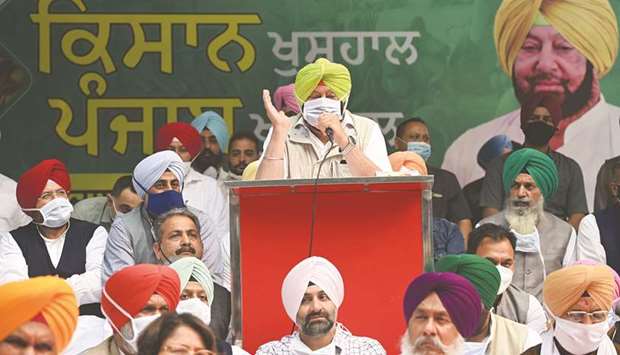
Punjab Chief Minister Amarinder Singh addresses a gathering of farmers during a protest against the recent passing of agriculture reform bills in the parliament, in New Delhi yesterday.