


The Gas Processing Centre (GPC) at Qatar University (QU) and ConocoPhillips has completed the second phase of the pilot project for the wastewater volume reduction for oil and gas filed operations.
In Qatar, the regulations by Qatar Petroleum require 50% reduction in liquid discharge from all oil and gas processing facilities. Therefore, the project was aimed to address the challenge by implementing the low-energy technology “Osmotic Concentration (OC)” based on the natural osmosis phenomenon principles for volume reduction of wastewater.
ConocoPhillips Global Water Sustainability Centre (GWSC) research team demonstrated the proof of concept for the OC process at bench-scale level in 2016. The bench-scale system proved the technology feasibility for 50% volume reduction of wastewater. Therefore, the promising outcomes encouraged scaling up the project into higher level. Consequently, the investigation of OC technology at pilot-scale level is proposed as a joint project between GPC and ConocoPhillips GWSC.
The project named “Osmotic concentration for reducing injected wastewater volumes in Qatar”, launched in 2018 and funded by Qatar National Research Fund, demonstrated the technical viability of the technology. This resulted in 75% reduction of the disposal volume with minimal environmental impact, and at a much lower cost compared to the state of the art technology that is currently being implemented in the field.
The pilot project was completed on October 1 with a virtual meeting organised by GPC and attended by various managerial and technical dignitaries, including Sheikh Khalid bin Abdulla al-Thani, chief engineering and projects officer, Qatargas; Dr Khalid Naji, dean, College of Engineering, QU; Prof Muftah El-Naas, GPC director; Todd Creeger, president of ConocoPhillips, Qatar and other dignitaries from Qatar University, Qatargas, and ConocoPhillips.
The research team led by Dr Mustafa Nasser from QU and Dr Samer Adham from ConocoPhillips GWSC presented the main outcomes of the project and also spoke highly of the project team and the successful demonstration of an emerging technology that has direct application in Qatar.
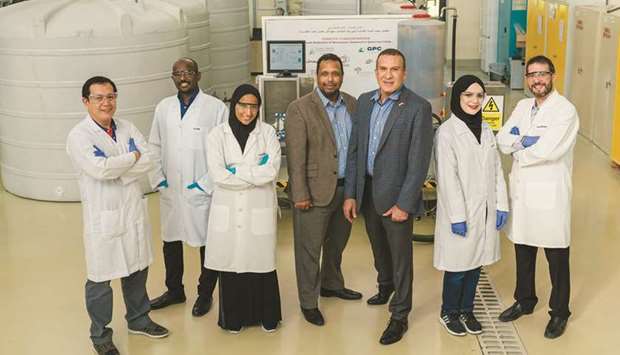
ConocoPhillips, GPC-QU team members.