


A unique exhibition, running until April 10, 2021 at the Museum of Islamic Art (MIA), provides an opportunity for many residents and visitors to see more than 300 extraordinary works of art acquired by one of Qatar’s greatest collectors.
“‘A Falcon’s Eye: Tribute To Sheikh Saoud Al Thani’ exhibition celebrates the outstanding accomplishments of the individual who was largely responsible for laying the foundation for QM’s world-class collections,” QM said on its Instagram post yesterday.
According to QM, the art works on show were from prehistoric fossils and Egyptian antiquities to Orientalist paintings and masterpieces of the history of photography in a spectacular display following the concept of ancient (Renaissance) “cabinet of curiosities” reflecting HE Sheikh Saoud’s fascination with both natural history and the art world.
QM said on its website that MIA pays tribute to HE Sheikh Saoud “who was so influential in the constitution of collections for QM and Qatar in general.”
“Sheikh Saoud’s legacy as a collector is of crucial importance to QM as he laid the foundations of the major collections within the institution. Parts of that collection are on display at MIA, but others remain in storage. This exhibition sheds light on objects that have never been displayed in Qatar before,” QM added.
The collections range in date from the prehistoric Holocene period to the early 2000s and in geography from South America and Europe to the Arabian Gulf and China. These sweeping displays are presented in distinct, thematic groups reminiscent of the “cabinets of curiosities” or Wunderkammer that individual collectors assembled in the centuries before the first modern museums were established, and that fascinated Sheikh Saoud.
“Sheikh Saoud was passionate about ‘cabinets of curiosities’ and the combination between natural history and antiquities in particular.
The exhibition celebrates his collecting vision through an eclectic display including natural history, antiquities, jewellery, photography and modern and contemporary artworks that recalls the ‘cabinets of curiosities’ tradition” QM added.
One of his collections includes a portrait of Emperor Rudolf II Habsburg, considered one of the most important art patrons in the 16th century.
His collection was housed in a famous curiosity cabinet in Prague, the Kunstkammer. Another unique piece is the La Tolita’ mask from Ecuador, Tumaco region, between 300 BCE and 400 CE (hammered platinum with gold, and turquoise beads).
“Masks of this kind were found in South America in tombs (or tolas) of kings and represented the dual power over life and death of the shamans or chief magicians,” QM said.
Part of Sheikh Saoud’s collection is a 478.68-carat sapphire of Sri Lankan origin – known to be Queen Marie of Romania’s Sapphire Pendant (Produced by Cartier, Paris, 1913) – and was exhibited in Spain in 1919. According to QM, the piece was acquired by King Ferdinand of Romania in 1921 for Queen Marie (1875-1938), who was the granddaughter of both Queen Victoria of Great Britain and Czar Alexander II of Russia. “Despite the fact that the Gulf region has a longstanding history of collecting practices, Sheikh Saoud can be considered one of the last royals who amassed thousands of very diverse objects for his country with a real passion and eye for arts and culture,” QM said. “To his vast collections, he added a conservation facility to preserve and breed endangered species at his Al-Wabra farm, which gained world-wide admiration.”
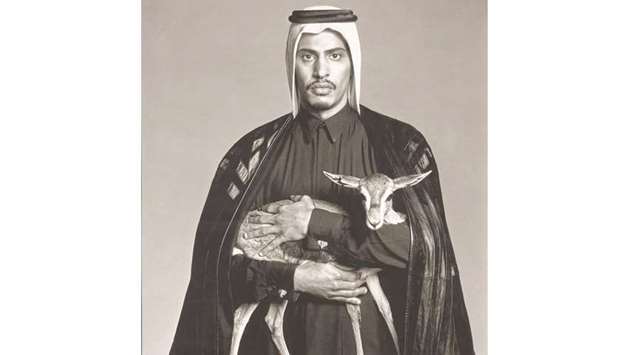
HE Sheikh Saoud al-Thani