


The resurgent coronavirus disrupted the EU leaders’ summit, only their third face-to-face meeting since the pandemic began, with the EU’s chief executive and Finland’s prime minister dropping out after coming near people who later tested positive.
The coronavirus causes the Covid-19 respiratory disease.
A European Union diplomat said this week’s meeting was likely to be “the last physical gathering of EU leaders for a while” as the second wave of Covid-19 brings record daily infections and forces governments to restrict lives again.
Europe’s economy is in its worst-ever recession after spring lockdowns hit travel and tourism, and with leaders still struggling to agree a common approach to tackling the pandemic, businesses are again fretting about their futures.
European Commission President Ursula von der Leyen abruptly left the two-day summit less than an hour after it started on Thursday, followed by Finnish Premier Sanna Marin yesterday.
Polish Prime Minister Mateusz Morawiecki was not present either as he was self-isolating in Warsaw even before the talks, at which leaders wore face masks.
Danish Prime Minister Mette Frederiksen had said on arriving in Brussels that the summit “should be held as a video conference ... instead of meeting physically”.
Leaders agreed to hold video calls to co-ordinate measures to combat the pandemic among the bloc’s 27 countries.
“There was an agreement that we would, almost weekly now, engage in consultation with each other in terms of best methods and the best approaches to deal with this second wave,” said Irish Prime Minister Micheal Martin.
Virtual conferences are less effective for agreeing complex compromises but safer than in-person meetings that increase the risks of infection among EU leaders and their staff.
Italy’s Prime Minister Giuseppe Conte said the regular calls would help co-ordinate moves on tracing, restrictive measures, vaccines and therapies.
The EU’s 27 nations fought Covid-19 with different, sometimes contradictory measures in the first months of the pandemic and often clashed over travel restrictions or access to medical supplies.
They have since committed to joint vaccine procurement and agreed shared criteria to assess the situation in any specific country so that it is easier to make comparisons and stage a common fight against the virus.
But measures still differ between countries, including quarantine length for those who have been in contact with infected people, which was 14 days across the bloc until a few weeks ago, when some countries began cutting it.
Some EU countries have switched schools and universities back to online learning or while some tell people to wear face masks including on the streets and others do not.
Testing levels also vary widely.
Meanwhile, Italy has registered 10,010 new coronavirus infections over the past 24 hours, the health ministry said yesterday, the highest daily tally since the start of the country’s outbreak and up from the previous record of 8,804 posted on Thursday.
The ministry also reported 55 Covid-related deaths, down from 83 the day before and far fewer than at the height of the pandemic in Italy in March and April when a daily peak of more than 900 fatalities was reached.
The number of coronavirus sufferers in intensive care continued to rise, reaching 638 yesterday from 586 on Thursday and compared with a low of around 40 in the second half of July.
Italy was the first country in Europe to be slammed by Covid-19 and has the second-highest death toll in the continent after Britain, with 36,427 fatalities since the outbreak flared in February, according to official figures.
The Italian government on Tuesday imposed new restrictions on gatherings, restaurants, sports and school activities in an attempt to slow the surge of infections.
However, some experts said the measures were too limited and some local leaders have since announced more aggressive action for their regions.
Greece meanwhile recorded 508 new confirmed coronavirus infections yesterday, topping the 500 daily mark for the first time, health authorities said, as they urged compliance with mask wearing and social distancing.
Of the 508 new cases, 227 were recorded in the Athens metropolitan area and 63 in Thessaloniki, the country’s second largest city.
There were eight deaths from the disease.
“For the first time we went over 500 daily diagnoses of coronavirus,” said epidemiologist Gikas Magiorkinis. “The drop in temperatures may tilt the balance, intensifying the epidemiological trend.”
Earlier, Greek Prime Minister Kyriakos Mitsotakis told reporters after an EU leaders’ summit in Brussels that Greece was still among the countries faring better in Europe.
“But this may change at any moment if we do not comply with the recommended measures,” he said.
Poland reported a new daily record of 132 coronavirus-related deaths and counted 7,705 new confirmed cases, amid fears the pandemic is testing the country’s supply of hospital beds and ventilators.
The government urged Poles to travel outside of the country only if absolutely necessary, following a daily record of 8,099 new confirmed coronavirus cases on Thursday.
Authorities on Thursday introduced new restrictions, including closing all gyms and pools and placing limits on the size of weddings or banning them altogether in some regions.
The government has said that it is trying to avoid a total lockdown, but further restrictions are not ruled out if cases keep increasing.
A number of major cities, including the capital Warsaw, have been marked as red zones, where the strictest limits apply.
Poland now has 157,608 confirmed coronavirus cases and 3,440 deaths.
Slovakia reported more than 2,000 new daily cases of the novel coronavirus for the first time yesterday, meaning the country now has one of the fastest infection rates in Europe.
The central European country was among the most successful at containing the virus during the pandemic’s first wave in the spring.
But like the rest of Europe it is facing a stronger second wave, a test for the government as it seeks to avoid another strict lockdown while curbing the virus’s spread.
The health ministry recorded 2,075 new Covid-19 cases on Thursday to bring the total in the country of 5.5mn to 26,300 since March.
Of those, 19,047 are considered active, a threefold increase in October alone, while 7,182 have recovered and 71 people have died.
The Netherlands hit another new record in daily coronavirus cases, with nearly 8,000 infections in the past 24 hours, data released yesterday showed.
The number of confirmed cases reached 7,984, according to daily figures compiled by the National Institute for Public Health (RIVM).
The Kremlin said yesterday that it was worried by a record surge in Covid-19 cases in Russia, but that the situation was under control.
Russia reported a record high of 15,150 new coronavirus cases in the previous 24 hours, including 5,049 detected in the capital Moscow.
Nearly all of Moscow’s pre-trial detention facilities have stopped taking in new suspects as a precaution, the Tass news agency cited a prison monitor group as saying.
“The Kremlin is indeed worried by these statistics. We see the epidemic is spreading substantially,” Kremlin spokesman Dmitry Peskov told reporters. “The situation is currently under control despite this sad trend.”
Sergei Sobyanin, the mayor of Moscow, the worst-affected area, has said this week could prove decisive in trying to curb the spread of the virus.
Russia, which has a population of around 145mn, has reported 1,369,313 cases since the pandemic began.
Switzerland reported another daily record of 3,105 new coronavirus cases yesterday.
The public health agency reported a total of 74,422 confirmed cases in Switzerland and neighbouring principality Liechtenstein.
The death toll rose by five people to 1,823.
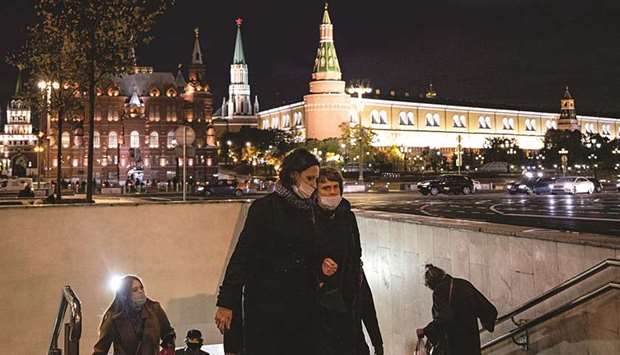
People walk out of an underground passage in Moscow yesterday amid the coronavirus pandemic.