


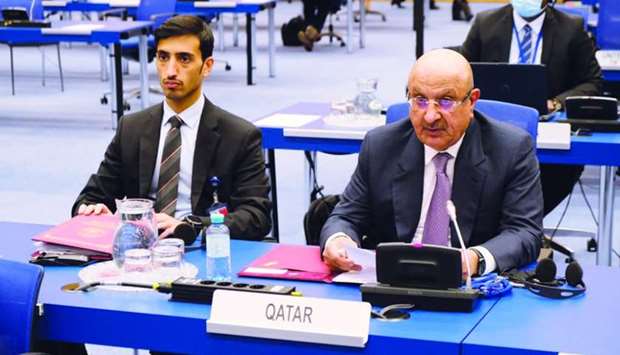
Qatar has called for building an international consensus on a comprehensive international agreement on combating the use of information and communication technologies for criminal purposes, that integrates into its framework and does not exclude any of the existing international and regional instruments.
Addressing the 10th Conference of the Parties to the United Nations Convention against Transnational Organised Crime (COP10), currently in session in Vienna, HE Maj. Gen. Dr Abdullah Yousef al-Mal, the Adviser to HE the Minister of Interior and Chairman of the Follow-up Committee on the Implementation of the Doha Declaration Global Programme, underlined the need to confront the safe havens of illicit financial flows, the crime-based economy, corruption, money laundering and drug trafficking, as well as the need to promote measures that aim at uncovering the proceeds of crime and their safe havens.
He called for a greater international attention to the new crimes, in particular cybercrime which poses an increasing risk for everyone, noting that Qatar was among the victims of cybercrime and the use of cyberspace to hack its news and sports sites and to violate the intellectual property rights of Qatari companies.
On the 20th anniversary of the Convention against Transnational Organised Crime, HE Dr al-Mal said that this convention has become a pioneering model and an important tool in the international pluralism system and in the rule of law in international relations. It also helped in strengthening multilateral institutions and the interdependence between sustainable development and the rule of law, contributing towards peace and stability in the world, and confronting the tendencies of unilateralism, closure and adventurous policies that violate international law.
He added that Qatar is proud of its role in supporting the convention and implementing its provisions at the national and international levels, as well as for hosting of the 13th Congress on Crime Prevention and Criminal Justice in 2015, and the issuance of its historic declaration, the Doha Declaration, which was a milestone in the joint effort.
Qatar added to this effort by funding the Doha Declaration Global Programme, the largest programme ever offered by one country in the history of the United Nations Office on Drugs and Crime (UNODC). The programme has become a model for the support provided by states to the UNODC.
He reviewed the achievements accomplished by the Doha Declaration Global Programme, and said that more than 52,000 people from 186 countries benefited from direct capacity building activities.
The programme reached out to 2mn people from more than 190 countries, and produced more than 200 educational materials, while reaching out to 1.2mn children and students.
In the Judicial Integrity pillar, the programme trained 1,600 judges, while 50 jurisdictions from different countries of the world became experimental sites for training tools on judicial practices and ethics.
In addition, the programme supported 11 countries in the field of prison infrastructure and the rehabilitation of prisoners.
Within the framework of the youth crime prevention pillar, the programme trained 13,000 young people.
HE Dr al-Mal underlined that the Doha Declaration Global Programme continues to provide more for the sustainable development and the rule of law in international relations.